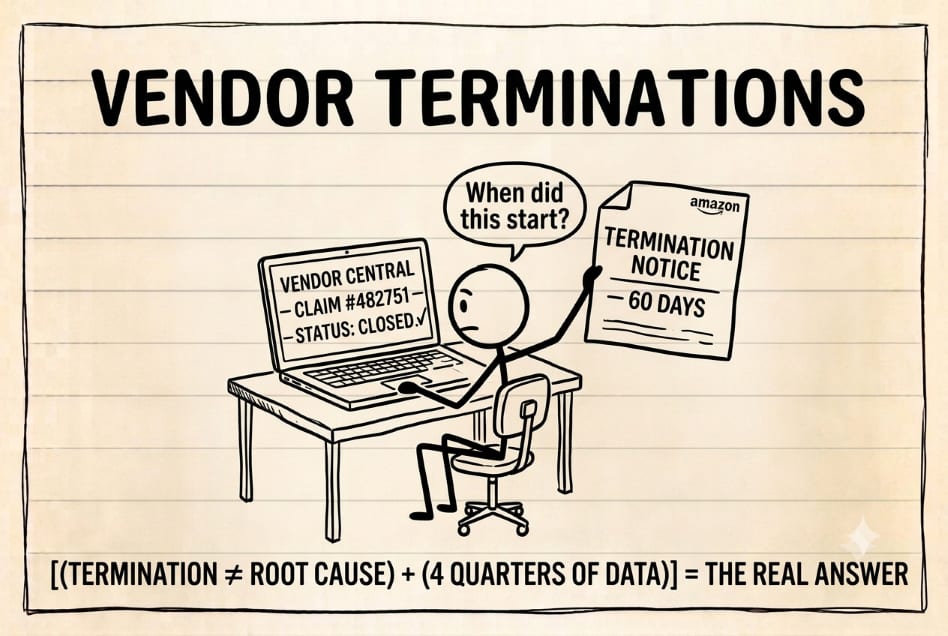
Amazon's 1P termination notice usually gives 30 to 60 days before purchase orders stop, and the decision is almost always algorithmic once it lands. Community operators report the cut is driven by contribution margin and Net PPM, not by revenue alone. A 42% Net PPM account can be terminated if its category is competitive. Open shortage claims stay disputable inside the notice window, and your audit posture is the single lever left.
Based on r/VendorCentral community operators reporting terminations across US and EU accounts in Q2 to Q3 2026, plus public Amazon Vendor Central program guidance, September 2026. Amazon does not publish termination thresholds, so treat the specific figures below as vendor-reported patterns rather than policy.
You run e-commerce at a $18M CPG brand that has moved a third of its volume through Amazon 1P for six years, and on a Tuesday afternoon the email arrives. Sixty days of notice, a named final-PO date, and a polite paragraph pointing you at your Vendor Manager. Two people on your team are paid partly out of that Amazon channel, $340K of inventory built to Amazon’s forecast is in the warehouse right now, and a shortage-claim dispute you filed six weeks ago is still open in Vendor Central with no resolution in sight.
You reopen the email three times because your first read did not carry any specifics you can act on. Every affected vendor on r/VendorCentral is sharing the same four-sentence template:
Notice of termination of business relationship
As part of Amazon’s regular review of product offerings and a strategic realignment aimed at optimizing our operations and to better serve our customers, we’ve made the decision to stop sourcing products from your company.
Effective xxxx 2026, our vendor relationship will be terminated. We will not be entering into any new agreements or extending current ones beyond this termination date.
No cause, no path back, and no mention of the open claims, the AVS holdback sitting on your remittance for two months, or the co-op billback you are still trying to reconcile. The r/VendorCentral thread collecting 34 vendor comments on exactly this template is the clearest source on the shape of the current wave, and Phazze, a vendor operator with a working VM relationship, gives the number to hold on to:
Its nothing new, yearly terminations for accounts under performing in net ppm or monthly cogs is going to be usual from now on, last time I spoke with our VM out of 120 accounts he manages, 5 were in good standing in terms of net ppm.
Five in 120. Treat the 96% as one operator’s data point rather than policy, and the email in front of you stops being a signal about your brand and starts being a signal about the size of Amazon’s cut list this year.
What the notice period actually says
The email names two things and nothing else: the effective date and the last PO window. The rest is procedural boilerplate, and the sooner you read the notice as an outcome rather than an opening move, the more useful the next 30 to 60 days become.
Consulterce, a recovery operator on the thread, gives the appeal path in one sentence worth memorising:
it’s a set decision unless you were part of an algorithmic decision and have still contact to a VM who wants to work with you. They’re the only ones able to override the system.
Two cases split out of that:
- Algorithm made the call, and your VM relationship is intact. A narrow but real path back through the VM exists, and the notice window is what you use to work it.
- Algorithm made the call, and your VM has already flagged you as unwilling to work on Net PPM. The human override is gone, and the notice window is for closure work rather than appeals.
What happens to your open POs and claims inside the window
Nothing about your operational relationship pauses when the notice arrives. POs still ship, chargebacks still fire, and disputes still run on the same clock, so the window is for triaging four workstreams:
- Remaining POs. They ship, invoice, and get audited exactly like last quarter. Every clean shipment is money that stays with you, and every ASN Accuracy chargeback still fires against a pre-transmission validation gap you have been running all year, so fix the validation on the last 30 days of shipments if you can.
- New disputes. Shortage claims filed inside the window move through Vendor Central on the normal 30-day dispute rule, and credits post on the usual remittance cycle as long as they resolve before the closure date.
- Open disputes filed earlier. Anything unresolved at closure enters Amazon’s post-termination case queue, and multiple operators on the thread report that queue is slower and less responsive. Accelerate every open case rather than let it drift.
- Closed shortage claims from earlier quarters. Re-audit the last 90 days against the three failure modes covered in Post 1. One finance analyst, one afternoon, and any credit still due posts before the account closes rather than after.
Why revenue did not protect you
Chief241, a low-volume operator with a strong margin, states the surprise up front:
We had a 42% net ppm and got cut out. We are low volume but it was still a lot for our small company.
Artiss92 explains the pairing:
The criteria seems to be principally on total revenue, and contribution margin (meaning if you sell low Average Selling Price products at 40%+ Net PPM but your contribution margin for Amazon is negative, you’ll likely be impacted).
Two metrics carry the weight and they are not the same:
- Your Net PPM measures your profitability at Amazon’s shelf price.
- Amazon’s contribution margin measures Amazon’s profitability after warehousing, shipping, marketing spend, and the VM’s own time cost get allocated back to your account.
A high-margin, low-volume account can be positive on the first line and negative on the second, and Amazon is the one making the call. The tier system Artiss92 describes, with a tier-two VM owning 40 to 120 accounts, pushes any account not worth active management on both axes down the priority list until it exits.
The four-quarter view in the diagram above is what would have caught the pattern earlier, and every one of these signals is measurable inside your own data before the VM meeting turns aggressive:
- Chargeback volume trend, pulled from Vendor Central’s operational report by category.
- Net PPM slope against category median, quarter over quarter.
- ASN accuracy rate against the 95% threshold at which AVS holdbacks and shortage claims start to grow.
- Dispute win rate, tracked against the 30-day chargeback window and two-attempt limit.
The OTIF Deduction Root-Cause Assessment is the version of that audit we productise for the deduction and compliance side, and the Data-Bridge Friction Assessment covers the ERP-and-EDI side where most Net PPM erosion actually originates.
What to walk in with, if the VM will take a meeting
Deathtongue1985 lists what an appeal-adjacent conversation actually needs:
T12 month sales to customers, 12 month pcogs (or shipped cogs), Net ppm and trends, ASP, units, Ad spend, promo and or B2B deal funding etc. Also, T12 non Amazon sales dafa…are you purely an Amazon brand? Or do you have significant brand equity, branded demand? How competitive is your category? Do you have direct competitors that are also Amazon vendors?
Turn that into a one-page brief before you take any meeting, VM or otherwise:
- Trailing twelve months of sales, pCOGS, and units by ASIN, so the profitability question has a number under it rather than an opinion.
- Net PPM trend by quarter plotted against category median, not just a single point.
- Ad spend, promo funding, and B2B deal funding as line items, because these are the levers Amazon expects to see moved in an appeal conversation.
- Non-Amazon revenue mix, because independent brand demand is the strongest single argument a VM can escalate to a category manager.
- Category competitiveness, named: how many direct-substitute vendors exist, and whether any are on the same cut list.
The same brief is what a broker, a 3P transition consultant, or a 1P distributor needs to give you a real read on post-termination options.
Whether the exit is a downgrade depends on the category
Witty_Second_8026 made the switch to a 1P distributor and describes it as a simplification:
I went with a 1P distributor, done dealing directly with Amazon and simplified my life! I control my brand and listing 100%. I don’t worry about Amazon’s rising fees and get paid every 30 days like clockwork. I make more now compared to when I was on 3P. I have time now as well, no more Amazon operational headaches and worries.
Fadedblackleggings pushes back with the counter every founder hears from their board:
You just gave away your profit margin and brand control.
Both are true, and the honest answer depends on four things:
- Distributor route works when your brand has independent off-Amazon demand, your category is competitive enough that 1P’s traffic advantage is a wash, and you would rather trade a slice of margin for stable 30-day payment terms than keep fighting the VM.
- Distributor route hurts when your brand only lives on Amazon, your category has close substitutes, and Amazon’s traffic (not your name) was the actual leverage.
- 3P works when you can operate the Seller Central account competently and your unit economics survive Amazon’s referral, FBA, and storage fees at the price Amazon currently retails. The 1P to 3P transition guide maps the full operational shift.
- 3P hurts when the CFO underestimates the operational load of running the account, or when Amazon aggressively suppresses your buybox as a former 1P.
Talk to at least two operators who have made the transition in your specific category, and read the what OTIF costs at retail piece if your next channel involves Walmart or Target, because the deduction shape at other retailers is not the same as Amazon’s.
The audit posture is the lever
Q4 books close in 90 days regardless of the termination date on your email. Two workstreams pay for themselves this week:
- The 90-day re-audit on your closed Amazon shortage claims, per the three failure modes in Post 1.
- The four-quarter measurable pull on your own data, so every conversation that follows this notice has real numbers under it.
If the pattern that put you on Amazon’s cut list is still running inside your ERP, your EDI validations, or your ASN generation, the next retailer picks it up on their own scorecard about 18 months from now, and the notice you get from them will read exactly like the one on your desk right now.
Book the audit hour before Q4 buries the pattern for another quarter.
Frequently Asked Questions
- How much notice does Amazon give before terminating a 1P vendor account?
- Community operators on r/VendorCentral report notice periods running 30 to 60 days, occasionally two months, before Amazon stops issuing purchase orders. Some accounts get an intermediate ramp-down where PO volume drops sharply before the final cut. The termination email itself names the effective date and the last PO window. Amazon does not publish a standard notice period, so treat any figure as a data point, not a rule.
- Can you appeal an Amazon 1P vendor termination?
- Rarely, and only when the decision was algorithmic rather than a Vendor Manager judgment. One recovery operator on r/VendorCentral put it plainly: it is a set decision unless you were part of an algorithmic decision and still have contact with a Vendor Manager willing to work with you, because a VM is the only role that can override the system. If a VM already flagged your account as unwilling to work on Net PPM, the appeal path is effectively closed.
- What criteria triggers an Amazon 1P vendor termination?
- Vendor Managers who spoke on r/VendorCentral describe two main criteria: contribution margin for Amazon and Net PPM trend. Revenue alone does not protect an account. One operator reported a 42% Net PPM account was terminated because its category was highly competitive with many direct substitute vendors. Under-10M annual revenue accounts are reportedly a common target in the current wave. Amazon does not publish the thresholds.
- What happens to open shortage claims after a 1P termination notice?
- Open shortage and chargeback disputes stay in Vendor Central through the notice window and remain disputable under Amazon's normal rules. The 30-day dispute deadline from the chargeback notification still applies. Any credit that posts before the account closes goes through the final remittance cycle. Anything filed but unresolved at closure may need to be pursued through Amazon's post-termination case queue, which multiple operators report is slower and less responsive.
- Should you move to 3P selling after a 1P termination?
- Community operators are split. One vendor on r/VendorCentral reported moving to a 1P distributor and calling it a simplification. Another countered that the switch surrenders margin and brand control. The right answer depends on your category, your Net PPM at Amazon's shelf price, your non-Amazon revenue mix, and whether your brand carries independent demand. Talk to at least two operators who have made the transition in your category before deciding.
Find out what your deductions are actually costing you.
A 30-minute call with the founder, who will tell you which of the three scans fits your problem, or that none of them do.