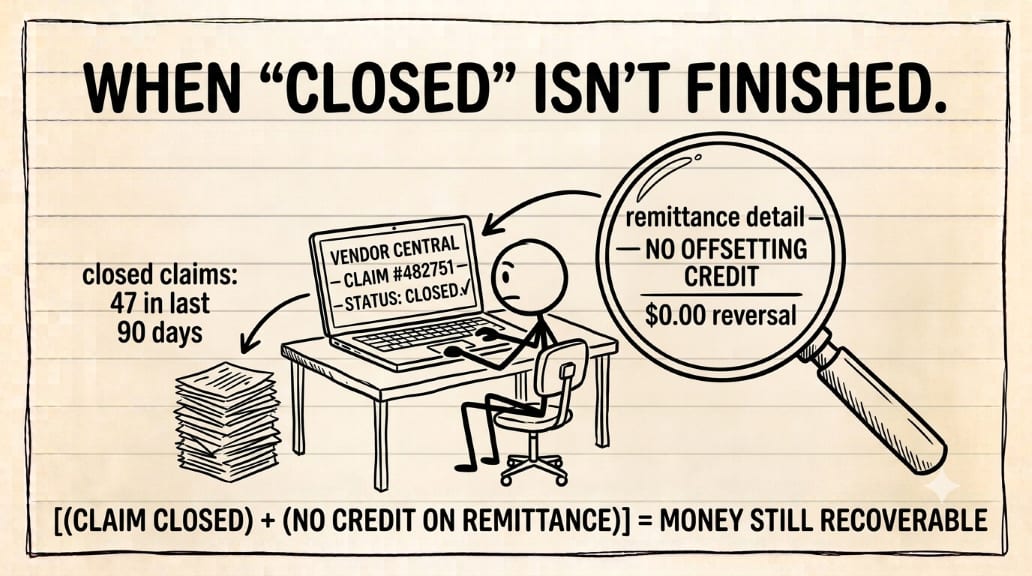
Amazon marks a shortage claim closed when it exits the workflow, not when a credit posts to your remittance. Three failure modes leak money past a closed status: no offsetting credit, multi-PO shortages split across claim IDs, and a post-close dispute path most vendors miss. A 90-day re-audit is the highest-ROI hour of the quarter.
Based on public Amazon Vendor Central documentation, SPS Commerce and Inmar deduction benchmarks, and community-reported patterns from 1P suppliers, September 2026. Amazon's specific dispute-window language changes periodically. Confirm current windows in your own Vendor Central case portal before writing off a claim.
It’s Friday afternoon, five days before Q3 books close, and you’re running finance at a $30M Amazon 1P brand. Your Vendor Central queue is finally quiet. Every shortage claim you fought this quarter now shows the same green Closed tick, and the plan for Monday morning is to file the Q3 folder and turn to the holiday forecast the rest of the company has been asking about since August.
Then you spot a line item in an old email, a $4,200 shortage claim you filed back in July and Vendor Central closed in early August, and you can’t quite remember whether the credit actually came back. The thread trails off in a Vendor Central reply and a “we’ll get back to you,” so you pull the remittance detail for that week to check. The credit isn’t there.
You pull the remittance for the next week. It isn’t there either. And the more remittances you open, the more Closed claims you find that never made the trip from the claims system into your bank account, which is the moment the quiet queue stops being reassuring.
That single missing credit is exactly the pattern one Amazon vendor described in a widely-read r/VendorCentral thread on closed but recoverable shortage claims, where 18 commenters compared notes on money they had already written off.
The thread’s takeaway is simple, and it’s the one this piece is built around. Closed is a workflow status, not a payment status, and re-auditing a quarter of them before the books close is the single highest-ROI hour of your Q3 wrap.
One commenter on that thread, a vendor operator using the handle Vendorist, put the underlying principle bluntly, and it’s worth quoting in their own words before we get into the mechanics:
If you’ve concluded that the only realistic outcome is recovery through VM escalation, we should probably compare notes. I’ve found that treating shortage deductions as end-to-end operational investigations rather than isolated claims can change both the conversation and, frequently, the outcome.
What does “closed” mean in Vendor Central?
Click into any of those closed claims and Amazon will tell you the case has exited its active queue. That’s the entire meaning of the word. Nothing on the screen confirms a payment reached your remittance, or that a human reviewed the evidence you submitted, or that the offsetting credit made the trip from the claims system to the payment system without falling out of a handoff somewhere along the way.
Vendor Central shows a green tick either way, which is the whole reason this hides in plain sight. Three different outcomes wear the same status: paid, denied, and never-actually-paid. The last one is the interesting one, because the case history usually shows nothing wrong. The claim opened, evidence went in, the status moved, and then the payment side quietly did not do its half of the job.
Most of the closed claims in your queue are tied to Amazon’s ASN Accuracy chargeback family, so the audit method below applies whether the underlying deduction was for missing units or for a receiving-scan mismatch.
The gap isn’t adversarial, and it doesn’t help to frame it that way. It’s procedural. Amazon’s claims workflow and its accounts-payable workflow are two different systems that trade messages, and every trade is a chance for a message to drop. When one does, the case still closes on schedule. The credit doesn’t. And no one at Amazon reconciles the two on your behalf.
Which brings us to the audit.
Three ways a closed claim still has money in it
The claim closed. The credit never came back.
Pull every closed shortage claim from the last ninety days and match each claim ID against every remittance in the same window. Any claim ID that never shows up in a credit memo is your candidate list. Match against the raw EDI 820 payment file, not the on-screen Payments summary. The summary rolls credits up, and the rolled-up view is exactly where a missing line hides.
Most of the money you’ll recover from this audit lives in this bucket.
The shortage was one shipment. Amazon issued two claim IDs.
When a single physical shipment covers more than one PO, and the receiver books shortages against each PO independently, you can end up with two claim IDs pointing at the same missing units. One might close with a credit. The other might close without one, stay open past the dispute window, or get denied because the ASN evidence you attached only matched one of the two POs.
The units are the same. The claims aren’t. Most vendors miss this on the first audit because their tracking spreadsheet groups by PO instead of by physical shipment, and the double-book is only visible once you flip the axis. If you’ve ever had one bad ASN turn into five separate chargebacks, you already know the shape of this failure.
The claim closed, but the current dispute process has a second bite you didn’t know about.
Amazon reworked the shortage-dispute workflow in 2025, and the older support-case path most vendors remember no longer works. The current process is two chances, not indefinite reopens, and the second chance is where most of the recoverable money lives. A recovery-service operator posting as RandyHoward laid out the shape of it in the same thread:
First, understand that Amazon changed its shortage claim process somewhat recently, back in 2025. It used to be that you could submit support cases to dispute shortages, but they no longer allow this. When support cases were allowed, we saw clients with 70%-90% success rate. After the change we’re seeing 40%-70% success rate.
The new process is this: 1. Traditional dispute. Submit the dispute as you normally would in VC. 2. Re-dispute. Submit a re-dispute against the old dispute if it was denied. These are now your only two chances to dispute an invoice.
You should not dispute until 35 days after the invoice due date. I have been in a meeting with an Amazon rep who explicitly told me this. Inventory can arrive late, or get misplaced in a warehouse, this allows time for items to be located.
Treat that 35-day rule as one operator’s reported experience, not policy Amazon publishes. It matches what several other commenters on the thread describe, but nothing on Vendor Central names an exact number, which is also why our reference table of retailer dispute deadlines doesn’t lock the Amazon windows down.
The practical read for a re-audit is straightforward. Any closed claim that never went through a re-dispute still has one attempt left inside the workflow, and a re-dispute request with fresh evidence, a related claim ID from failure mode two above, or an ASN timestamp you couldn’t attach the first time, costs you nothing to file.
Some vendors work through Amazon’s SPP recovery partners, third-party firms with API access, which one commenter reports can reopen closed cases up to two years old. If your volume justifies it, that path exists. For the finance lead running this audit inside a single afternoon, the built-in re-dispute is where you start.
What to pull before you reopen a closed claim
You need four things, and they live in four different systems, which is why this feels harder than it is. Our retail deduction evidence pack covers the general shape of the evidence bundle across retailers; the version below is the Amazon-specific cut.
The first is the claim’s own case history from Vendor Central, exported through the case detail on each claim ID. You want the timestamps for every status change, the evidence Amazon logged as received, and any notes the case queue left behind. If the notes say Amazon reviewed a specific document and rejected it, that reshapes the reopen argument. If they say nothing, you’re arguing into a silence, which is a different move.
The second is the corresponding remittance line, matched by claim ID rather than by dollar amount. If no line exists at all, that’s your finding. If a line exists but the amount doesn’t match the original deduction plus the expected reversal, that’s a different finding, and one that usually points to a units-versus-value reconciliation problem on Amazon’s side rather than your evidence.
The third is the ASN transmission proof, which your EDI provider stores raw. Whether that’s SPS Commerce, TrueCommerce, DataTrans, Stedi, Orderful, or an internal 856 feed, the transmission timestamp against the required ship date is what a shortage-claim reopen actually rests on when the dispute is about a receiving discrepancy.
If the 856 was rejected upstream and re-transmitted late, that’s a different kind of failure, and it shows up in the EDI 856 rejection patterns most vendors don’t audit until a chargeback names them.
The fourth is the proof of delivery, signed by the receiver at the DC. Amazon holds it inside its own Partnered Carrier portal if you shipped that way; otherwise your carrier’s platform has it. A signed POD showing full-case receipt is the single strongest piece of evidence for a shortage-claim reopen, and it’s also the one document most vendors don’t systematically archive.
If you’re looking at ninety days of remittance PDFs and don’t know where to start, our guide to reading a Walmart remittance advice walks through the reconciliation pattern step by step. The retailer is different, but the method is the same.
One process note surprises most vendors on their first re-dispute after the 2025 UI change. The default path under Dispute Management no longer accepts a reopen on a closed claim the way the old workflow did, and community operators report the working path is a Contact Us case routed to a Tier 2 team. Complete-Style-1159, a commenter with hands-on experience, described it plainly:
With the new UI for Dispute Management, this approach won’t work. You need to reach out to Tier 2 or get connected to the right team through “Contact Us” instead of using the default dispute path under “Dispute Management.”
If your first re-dispute attempt through the default UI comes back with “no further action available,” that’s the switch you’re missing, not a signal to give up on the claim.
What the audit looks like when we run it
The 8-section OTIF Deduction Root-Cause Report shows the exact deduction-ledger and root-cause-trace format we deliver on a 14-day assessment. The re-audit method above is the same one Section 3 walks through.
Read the sample →When to stop auditing
Not every closed claim has money hiding in it. Some are genuinely done, and the point of this audit isn’t to reopen everything. It’s to reopen the right things and move on before Q4 buries the pattern for another quarter.
Stop when the case notes carry an explicit denial with a documented reason. Amazon told you why. The reason may still be wrong, but reopening a denied claim with the same evidence that generated the denial isn’t the best use of the next hour. Only reopen a denied claim if you have genuinely new evidence you can name, not a fresh opinion about the old evidence.
Stop when the offsetting credit exists on the remittance and matches by claim ID. Amount alone isn’t enough, because the claims system and the payment system don’t always agree on cents, and the reconciliation you want is line-item rather than aggregate. Once the ID appears in a credit memo, the claim closed cleanly and you can move on.
Stop when both dispute chances are already spent. Under the current 2025 process, a claim that has been through the traditional dispute and the re-dispute is procedurally done inside the standard workflow, and every remaining hour is better spent on the pattern that generated the deduction in the first place.
If it printed forty-seven times last quarter, it will print forty-seven times this quarter unless something upstream changes. An SPP recovery partner may still be able to reach a fully-spent claim through the API, but that’s a separate engagement, not a re-audit hour.
That pattern is where the root-cause work lives, and it’s the reason the re-audit is a rescue mission rather than a business model. The OTIF Deduction Root-Cause Assessment picks up exactly there, tracing the three or four ERP-and-EDI failure modes that keep printing the same codes across quarters.
If the failure looks more like a system-to-system handoff problem than a compliance problem, the Data-Bridge Friction Assessment maps the re-keying and validation gaps where the deductions originate.
If you are evaluating a move from Vendor Central to Seller Central, run this re-audit before the transition. The 1P to 3P transition guide maps the operational shift, and your Net PPM and Contribution Margin position determines whether the math works on the other side.
Q3 isn’t done until the remittance says it is. Book the hour this week.
Frequently Asked Questions
- What does closed mean in Amazon Vendor Central?
- Closed means the shortage claim has exited Amazon's active workflow. The claim ID stops appearing in your open-cases queue. It does not confirm that an offsetting credit posted to your remittance. Closed is a workflow status, not a payment status. Cross-check every closed claim against remittance detail before writing it off.
- Can you dispute an Amazon shortage claim after it's closed?
- Sometimes, but the mechanism changed in 2025. Amazon retired the older support-case path, and the current workflow gives you two chances only: the traditional dispute in Vendor Central, and a re-dispute if the first is denied. Community operators report the re-dispute now routes through a Contact Us case to a Tier 2 team, not the default Dispute Management button. Waiting 35 days after invoice due date before the first dispute is a widely-reported best practice.
- How do multi-PO shortages get split across claim IDs?
- When one physical shipment covers multiple POs and the receiver books shortages against each PO independently, Amazon can generate one claim ID per PO. If two claims reference the same missing units from opposite sides, only one may get resolved. The other stays open, expires, or closes without payment. Look for related claim IDs before writing off any single closed claim.
- Is a re-audit of closed shortage claims worth the time?
- For most 1P suppliers, yes. SPS Commerce reports that suppliers dispute only 20 to 30 percent of deductions to begin with, which leaves most closed claims unaudited. A 90-day re-audit catches the three failure modes below without needing new software. One finance analyst, one afternoon, and the remittance detail is enough to find the pattern if it's there.
- What evidence do I need before reopening a closed claim?
- Match every closed claim to its remittance line. Pull the ASN transmission timestamp, the proof of delivery signed by the receiver, and any related claim IDs on the same PO. If the offsetting credit is missing on the remittance, or if the closed claim references units also disputed under a different open claim, you have grounds to reopen. Amazon reviews reopens on documentation, not on the reopen request alone.
Find out what your deductions are actually costing you.
A 30-minute call with the founder, who will tell you which of the three scans fits your problem, or that none of them do.