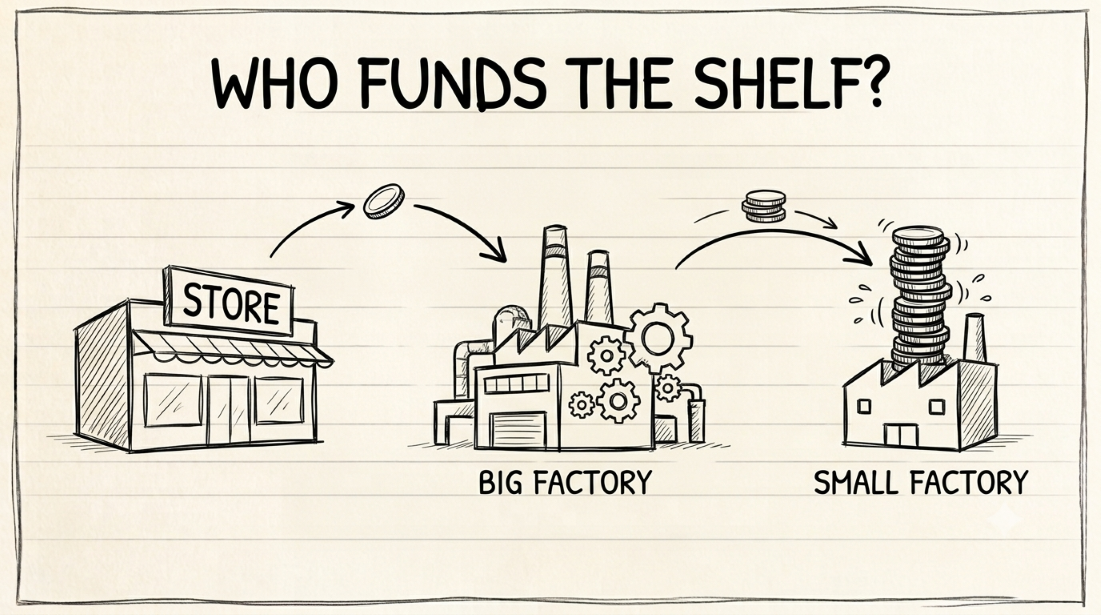
The median CPG company over $10B in revenue has a cash conversion cycle of about -3 days, so it collects before it pays suppliers. The median public CPG company under $10B carries a 68-day gap, per Pixels and Clicks analysis of SEC 10-K filings. Two free tools measure your own gap and customer concentration.
Based on Pixels and Clicks analysis of 10-K filings from 19 retailers and 58 CPG manufacturers, October 2026.
You run finance at a $50M consumer brand. Sales grew 12% last year, and your line of credit grew faster.
Your retailers pay on their terms, and your inventory turns look normal.
Every quarter, your lender still asks why borrowing outpaces revenue. You don’t have a clean answer.
Private brands don’t publish balance sheets, so you have no peers to compare against.
Public companies do publish theirs. We pulled 10-K filings from 19 retailers and 58 CPG manufacturers to see who funds the retail shelf.
The filings explain your credit line. Retailers run on their suppliers’ cash.
The largest CPG companies do the same to their own suppliers. Brands your size carry the difference.
We built two free tools from that data. The Float estimates what your cash gap costs you.
The Walmart Dependency Tracker compares your reliance on one customer with 60 public CPG companies.
Does Walmart owe its suppliers more than its inventory is worth?
Yes. At the end of January 2026, Walmart reported $63.1B in accounts payable.
Its inventory was $58.9B, according to its fiscal 2026 10-K.
Walmart’s unpaid bills to its vendors are larger than everything it holds in stock.
Walmart’s payables first passed 100% of its inventory in January 2018. That was before the 2021 inflation spike.
Accounts payable covers every vendor Walmart owes. The ratio measures funding by all its suppliers, not CPG brands alone.
How much longer do large CPG companies hold their suppliers’ bills?
Large CPG companies now hold their suppliers’ bills about twice as long as they did in 2009.
Days payable measures this: accounts payable divided by cost of sales, times 365. It’s a balance-sheet average, not a contract term.
P&G’s days payable rose from 56 in fiscal 2009 to 137 in fiscal 2026, according to its 10-K filings.
Walmart’s days payable is 43.
Take the 11 CPG companies with more than $10B in revenue and data for both years. Their median days payable rose from 52 in 2009 to 111 in 2025.
Why do smaller CPG brands carry a longer cash gap?
Smaller CPG brands hold their own suppliers’ bills for less time.
Big and small companies collect from customers at about the same speed, a median of about 33 days.
CPG companies over $10B hold their suppliers’ bills for a median 105 days. Those under $1B hold them for 34.
The cash conversion cycle is days to collect, plus days of inventory, minus days payable.
The median CPG company over $10B runs about -3 days. It collects before it pays.
The median public CPG company under $10B runs 68 days. It funds more than two months of its own working capital.
How much does your cash gap cost?
The Float calculator estimates your cash gap and what it costs you.
You enter your revenue, gross margin, days to collect, days of inventory and days to pay.
The calculator returns the cash your cycle ties up and its cost at your borrowing rate.
It also shows how much cash you’d free at the large-company median cycle.
One more input covers deductions in dispute. A retailer that short-pays an invoice holds that cash until you resolve the dispute.
The Float page also has data back to 2009 for every company and a CSV download. Every figure links to its 10-K.
Are CPG companies more dependent on Walmart than they were in 2009?
Most are. We found 22 public CPG companies that reported a Walmart share of sales in 2009 and 2024.
Of those 22 companies, 14 now depend on Walmart more.
Public companies must disclose any customer worth 10% or more of revenue under ASC 280-10-50-42.
Most CPG companies name that customer. We read those disclosures in 880 10-K filings.
John B. Sanfilippo reported the largest rise. Walmart was 19% of its net sales in fiscal 2009.
By fiscal 2026, Walmart was 41% of John B. Sanfilippo’s net sales, according to its fiscal 2026 10-K.
How does your customer concentration compare with public CPG companies?
The Walmart Dependency Tracker compares your customer concentration with public CPG companies.
You enter your largest customer’s share of your sales.
The Tracker shows how many public companies rely on Walmart more than you rely on that customer.
It also charts Walmart’s share of sales for every public CPG company that discloses it, from 2009 on.
Some public companies rely most on a customer other than Walmart. Hershey’s largest customer is McLane, a distributor, at about 27% of net sales.
Helen of Troy’s largest customer is Amazon, at 20% of net sales.
Which part of your cash gap can you recover?
Disputed deductions are the part of your cash gap you can recover without renegotiating terms.
Your payment terms with a large retailer rarely move. Your inventory days depend on supplier lead times.
Each disputed deduction is cash your retailer holds while you argue. Each one has a root cause you can trace and fix.
Start with the OTIF deduction calculator. It estimates your annual deduction exposure in about a minute.
The deduction assessment then traces every open deduction to its cause.
We also started The Deduction Census, the first industry-wide benchmark for CPG supplier deduction rates. It’s anonymous, free, and seeded with the same SEC data behind The Float. If you know your deduction rate but have no idea whether it’s normal, that’s where to check.
Both research pages use public-company data. Those companies are larger than most private brands.
Days payable and days to collect are year-end ratios, not payment terms.
The retailer and supplier figures are industry-level comparisons, not matched buyer-seller pairs. Each page’s methodology section lists the limits in full.
Frequently Asked Questions
- What is the cash conversion cycle for CPG companies?
- The cash conversion cycle is days to collect from customers, plus days of inventory, minus days payable. In 10-K filings analyzed by Pixels and Clicks, the median CPG company over $10B in revenue runs about -3 days. The median public CPG company under $10B runs 68 days. That company funds more than two months of its own working capital.
- Does Walmart owe its suppliers more than its inventory is worth?
- Yes, on its balance sheet. At the end of January 2026, Walmart reported $63.1B in accounts payable and $58.9B in inventory. Payables equaled 107% of inventory, up from 84% in January 2009. Accounts payable covers all of Walmart's vendors, not only CPG brands.
- How dependent are CPG companies on Walmart?
- Pixels and Clicks found 22 public CPG companies that reported Walmart's share of their sales in both 2009 and 2024. Of those, 14 now depend on Walmart more. Their median Walmart share rose from 18.5% to 22%. John B. Sanfilippo reported the largest rise, from 19% of net sales in fiscal 2009 to 41% in fiscal 2026.
- Is days payable the same as payment terms?
- No. Days payable is a balance-sheet ratio: accounts payable divided by cost of sales, times 365. It shows how long a company holds its bills on average. Payment terms are what a buyer and supplier agree in a contract. The two move together but are not the same number.
- Where can I download the data?
- Both datasets are free to download as CSV files from The Float and the Walmart Dependency Tracker on pixelsandclicks.net. Every figure links to the 10-K filing it comes from. You can use the charts and data in your own work with a link back.
Find out what your deductions are actually costing you.
A 30-minute call with the founder, who will tell you which of the three scans fits your problem, or that none of them do.