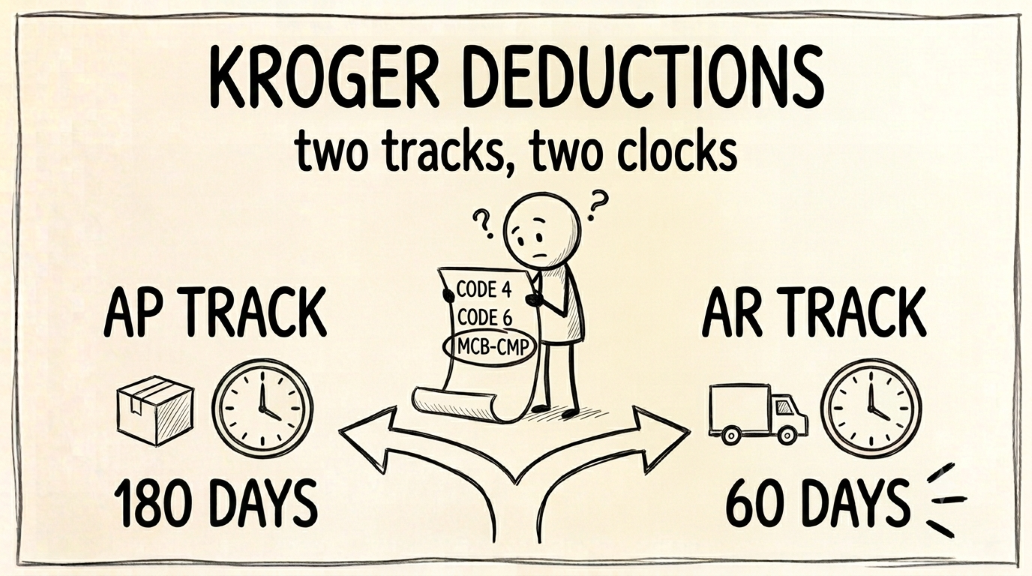
Kroger bills suppliers on two tracks. AP codes 2 through 9 cover shortages, cost differences, and promotional allowances, with 180 days to dispute. Compliance fees like ORAD and MCB post as AR deductions instead, and an MCB fee reportedly allows only 60 days. Disputes file through Supplier Connect, which replaced Lavante in late 2025.
Compiled from six independent public vendor sources (SPS Commerce, iNymbus, Confido, WarehouseQuote, ClearChain, SupplierWiki/SupplyPike), August 2026. Kroger does not publish this itself, so every figure here is vendor-reported and flagged where sources disagree. Confirm the code and window on your own Supplier Connect remittance detail.
A Kroger remittance arrives short, and the line explaining it reads “Code 4 - Shortage” or “MCB-CMP.” You have 180 days to dispute most of what appears there. If it is an MCB compliance fee, you reportedly have 60.
Miss either window and the deduction stops being disputable. It becomes a permanent write-off.
The structural trap is that Kroger bills you on two separate tracks that appear on the same document. Numeric AP codes cover shortages, cost differences, and promotional allowances. Compliance fees like ORAD and MCB post as AR deductions on a different claim path with a different clock.
A team that reconciles only the AP codes lets the compliance fees expire unclaimed.
Kroger publishes almost none of this itself, so every figure below is cross-referenced across at least two independent vendor sources and flagged where they disagree. The dispute portal also changed names in late 2025, which is why older guidance points at a system that no longer exists.
What does each Kroger deduction code mean?
| Code | Reported meaning | Family | Sources |
|---|---|---|---|
| 2 | Promo allowance difference (off-invoice) | Pricing | SPS Commerce, iNymbus |
| 3 | Cost difference (invoice vs PO unit price) | Pricing | SPS Commerce, iNymbus |
| 4 | Shortage / damage / do-not-stock | Shortage | SPS Commerce, iNymbus |
| 5 | EDI non-compliance | ASN/EDI | SPS Commerce, iNymbus |
| 6 | Unit shortage from supplier invoice | Shortage | SPS Commerce, iNymbus |
| 7 | Overage | Shortage | SPS Commerce, iNymbus |
| 8 | Net dollar difference (catch-all) | Pricing | SPS Commerce, iNymbus |
| 9 | Pickup allowance | Freight | SPS Commerce, iNymbus |
| SH | Shortage deduction | Shortage | iNymbus, Confido |
| LC | List cost deduction (billing above approved list) | Pricing | iNymbus, Confido |
| SD | Shorted deals (promo allowance not on gross invoice) | Pricing | iNymbus, Confido |
Sources disagree on how long the list runs. SPS Commerce documents eight numeric codes, iNymbus counts up to thirteen once letter codes are included, and Confido groups the same universe differently again.
Your Supplier Connect claim-type dropdown is the list that governs your account.
What compliance fees does Kroger charge on top of the AP codes?
ORAD, short for Original Requested Arrival Date, is Kroger’s late-delivery penalty. Per iNymbus, Kroger measures it against a 98% on-time threshold with a 95% case fill rate on every shipment.
SPS Commerce excludes ORAD from its numeric code guidance because it posts as AR rather than AP. No public source documents the fine amount at retailer-source quality.
MCB-CMP is the merchandising compliance fee, and it carries the tightest deadline on the page. Per ClearChain’s dispute guide, MCB fees allow 60 days from the issue date and file through the Kroger Supplier Hub rather than Supplier Connect.
Treat any MCB line as the short clock until your portal detail says otherwise.
WarehouseQuote reports that Kroger bills compliance as fixed-dollar penalties rather than a percentage of COGS, citing a $500 chargeback for a labeling error on a 50-case pallet regardless of product value.
That dollar figure is single-sourced, but the structural point holds across sources. Compliance fees are flat, so a violation on a low-value pallet costs exactly what the same violation costs on a high-value one.
Where do you dispute a Kroger deduction now that Lavante is gone?
Kroger replaced Lavante with Supplier Connect in late 2025. Per iNymbus’s transition note, PRGX still operates the platform, historical case data was migrated across, and authentication moved to Partner Pass with Okta Verify.
Anything you read that tells you to file in Lavante is describing a portal that no longer exists.
The mechanics survived the rename. You get 180 days from the deduction date, per SPS Commerce and Confido, and PRGX reviews the claim rather than a Kroger buyer.
One detail deserves more weight than it usually gets. Once you submit, you cannot modify the claim, so a dispute filed with incomplete documentation is a dispute lost rather than a dispute amended.
How does Kroger compare to Walmart, Target, and Amazon?
| Walmart | Target | Amazon | Kroger | |
|---|---|---|---|---|
| Code structure | ~90 numeric AP codes | ~250 codes across 9 prefixes | Named chargeback types | 8 numeric codes + letter codes + AR fees |
| Compliance fees | Same AP flow | VC prefix, two-step | Vendor Central chargebacks | Separate AR track (ORAD, MCB) |
| Dispute portal | APDP (Retail Link) | Synergy (Partners Online) | Vendor Central | Supplier Connect (PRGX) |
| Standard dispute window | Up to 2 years | 18 months (prepaid AP) | 30 days | 180 days |
Kroger’s window is a quarter of Walmart’s. If you run one deduction-review cadence across every retailer and it is calibrated to Walmart’s two years, Kroger claims are expiring inside it.
The dispute-deadlines table has all four retailers with their clocks side by side.
How do you stop Kroger deductions before the shipment leaves?
The pricing codes (2, 3, 8, LC, SD) all trace back to a disagreement between your item master, the PO, and the invoice. A three-way price match run inside the ERP before the EDI 810 transmits catches every one of them, which is the same control the Walmart code 10 price-difference entry describes.
The shortage codes (4, 6, SH) trace back to a gap between the quantity you invoiced and the quantity Kroger’s DC scanned. Build the ASN payload from the confirmed pick quantity rather than the order quantity, and validate it against physical carton count before transmission.
The EDI 856 pillar covers the six ways that ASN fails.
Code 5 posts when an EDI transaction fails or gets rejected downstream. A clean 997 acknowledgment does not protect you, because the 997 validates syntax only, and the 997 vs 824 comparison covers why the business rejection arrives weeks after the technical acceptance.
ORAD is the one that catches operationally sound suppliers. It measures against the Original Requested Arrival Date on the PO, not the actual delivery date, so a truck that arrives on the day it promised can still miss when the appointment window moved.
The buffer belongs in appointment scheduling, not in the transit plan.
Which Kroger deductions are worth disputing?
A single code 4 rarely repays the labor of assembling a claim. A recurring pattern of code 4s and ORAD fines does, and the pattern almost always resolves to one repeating root cause: an item master out of sync, an ASN built from the wrong quantity source, or an appointment measured against the wrong date.
Fix the cause once and the whole series stops.
Sizing that pattern in dollars is what decides whether it gets budget. The OTIF calculator does it across your full retailer mix rather than one line at a time.
If you also ship to Target, the vendor chargebacks guide covers a program that flags a violation before it deducts, which is a materially different clock to manage.
Nothing on this page comes from Kroger directly. Your Supplier Connect remittance detail carries the version that governs your account, and if it disagrees with anything here, tell us and we will correct the page.
Last reviewed: August 2026.
Frequently Asked Questions
- What deduction codes does Kroger use on a remittance?
- Vendor sources describe eight primary AP codes (2 through 9) covering promotional allowance differences, cost mismatches, shortages, EDI non-compliance, unit shortages, overages, net-dollar catch-alls, and pickup allowances. Letter codes like SH (shortage), LC (list cost), and SD (shorted deals) appear alongside the numeric list. Compliance fees like ORAD (late delivery) and MCB (merchandising) post separately as AR deductions, not AP.
- How long do I have to dispute a Kroger deduction?
- 180 days from the deduction date for standard AP deductions, per SPS Commerce and Confido. An MCB compliance fee reportedly allows only 60 days from the MCB issue date and files through the Kroger Supplier Hub instead, per ClearChain. Once a claim is submitted it cannot be modified, so documentation has to be complete before filing.
- What is the difference between Lavante and Supplier Connect?
- Lavante was Kroger's previous PRGX-hosted dispute portal. Supplier Connect is the replacement Kroger rolled out in late 2025 with the same operator, migrated historical data, and Partner Pass single sign-on, per iNymbus. The 180-day window and PRGX review did not change. Guidance published before mid-2026 still names Lavante, so treat it as stale on portal mechanics.
- What is a Kroger ORAD fine?
- ORAD stands for Original Requested Arrival Date, the delivery date on your Kroger PO. Miss it and Kroger applies a late-shipment fine. Per iNymbus, ORAD is tracked against a 98% on-time threshold with a 95% case fill rate on every shipment. ORAD fines post as AR deductions on a different claim path than the numeric AP codes, per SPS Commerce.
- How does Kroger's deduction program compare to Walmart's?
- Walmart runs roughly 90 AP codes, disputes through APDP, and allows up to two years on general deductions. Kroger runs eight numeric codes plus letter codes, disputes through Supplier Connect, and allows 180 days. Kroger also splits compliance fees onto a separate AR track, whereas Walmart deducts everything through the same AP flow.
Find out what your deductions are actually costing you.
A 30-minute call with the founder, who will tell you which of the three scans fits your problem, or that none of them do.