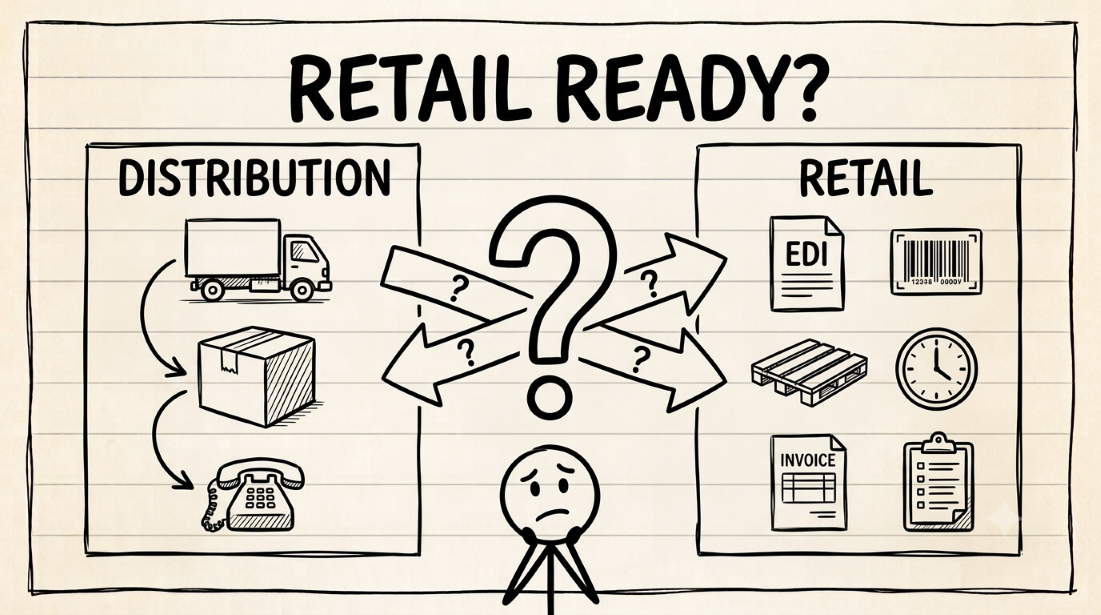
A CPG supplier is distribution-ready when it can ship product to a warehouse. It is retail-ready when every shipment meets a retailer's specific compliance rules for EDI, labeling, packaging, delivery windows, and invoicing. The gap between the two is where deductions start. Deductions run 5 to 15% of gross sales across the CPG sector, and most trace back to operational mismatches, not product defects. Closing the six gaps before the first PO ships is cheaper than disputing chargebacks after.
Based on public vendor compliance documentation from Bravo CPG, SPS Commerce, Productiv, Inmar, and OverDeduct benchmarks, September 2026. Individual retailer compliance thresholds and penalty structures vary by program.
You’re the founder of a $12M CPG brand, and you just landed your first Walmart PO. The product is ready. The packaging looks right. Your 3PL says they can ship it.
Six weeks later, a remittance arrives. The check is 8% lighter than the invoiced amount. Three line items are missing. Each one carries a code you’ve never seen before and a dollar amount deducted from your payment.
You didn’t ship late. You didn’t short the order. But your ASN transmitted four hours after the retailer’s cutoff, your case labels used the wrong barcode format, and your invoice listed a unit price that didn’t match the PO to the penny.
Inmar reports that deductions account for 5 to 15% of gross sales in the CPG sector. Average CPG net margins run 3 to 5%. A brand losing 8% to compliance deductions in its first retail quarter is not losing margin. It is losing money.
The product was distribution-ready. It was not retail-ready. Those are different things, and the gap between them is where deductions start.
Distribution-ready is a logistics problem. Retail-ready is a compliance problem.
A distribution-ready brand can move product from a warehouse to a customer. That means packaging, a freight partner, and a way to receive and process orders.
Retail-ready means something different. It means every shipment satisfies the retailer’s specific operational rules before the truck leaves, not just the customer’s product requirements.
The distinction matters because retailer compliance programs don’t grade on effort. They grade on data. Your ASN either transmitted before the cutoff or it didn’t. Your case labels either scan correctly or they don’t. Your invoice either matches the PO to the penny or it generates a deduction.
A brand selling through distributors or DTC can operate without EDI, without GS1-128 labeling, and without OTIF scoring. A brand selling into Walmart, Target, Kroger, or Amazon 1P cannot.
Why isn’t EDI optional for a new retail supplier?
Distribution-ready brands take orders by email, phone, or portal. Retail-ready brands exchange orders, ship notices, invoices, and acknowledgments electronically through EDI.
The core transactions are the EDI 856 (Advance Ship Notice), the EDI 810 (Invoice), and the 997/824 acknowledgment pair. Each retailer has its own mapping rules for these documents. Walmart’s 856 requirements are not Target’s. Amazon’s ASN accuracy chargeback measures units, not syntax.
The common first-year mistake is treating EDI as a setup task. You hire a VAN, run a test file, and move on. The problem surfaces weeks later when a field mapping that passed testing generates a mismatch in production. Your ASN says 120 eaches. The retailer expected 10 cases of 12. The receiving count reads short because the unit of measure didn’t match.
SPS Commerce reports that only 20 to 30% of deductions are ever disputed by suppliers. For a first-year brand, many of those undisputed deductions trace back to EDI mapping errors that nobody knew to check.
Why is retail labeling compliance retailer-specific?
A distribution-ready brand has UPC barcodes on its products. A retail-ready brand has GS1-128 shipping labels on every carton and pallet, formatted to the retailer’s specific requirements.
The GS1-128 label carries application identifiers for the SSCC (Serial Shipping Container Code), purchase order number, item GTIN, quantity, and production date. Each retailer specifies which fields are required, which barcode symbology to use, and where on the carton the label goes.
An unscannable barcode at the receiving dock doesn’t generate a conversation. It generates a chargeback. The dock worker scans, the scan fails, and the system records a discrepancy. That discrepancy becomes a deduction on your next remittance.
Productiv notes that labeling violations are among the most common compliance failures for new suppliers. The fix is configuration, not technology. But the configuration has to happen before the first shipment, not after the first chargeback.
Why is packaging configuration a compliance requirement, not a design choice?
Your packaging works for distributors. The case pack fits the pallet. The pallet fits the truck. The product arrives intact.
Retail-ready packaging goes further. Some retailers require shelf-ready packaging where the shipping carton becomes the display unit. Others specify case pack counts, pallet patterns, layer configurations, or stretch wrap requirements. The specs live in routing guides that run 40 to 80 pages.
A brand that ships the same case pack to Walmart and Target will eventually learn that one of them wanted a different configuration. The chargeback that teaches this lesson typically runs $100 to $500 per violation, and it repeats on every non-compliant shipment until you fix the configuration.
Read the routing guide before the first shipment. Not the summary. The guide. Home Depot’s routing guide alone covers carrier selection, appointment booking, labeling, and ASN timing, and violations on any of those generate chargebacks.
Why is OTIF a scoring system, not just an on-time delivery check?
Distribution-ready means you delivered the product. Retail-ready means you delivered the right quantity, to the right dock, inside the delivery window, with the ASN transmitted before the cutoff.
OTIF (On-Time In-Full) scoring measures both halves. Walmart requires 98% compliance. Prepaid suppliers must hit 90% on-time and 95% in-full separately. Target’s Perfect Order Program targets 100% on both dimensions. Kroger expects 98% on-time and 95% case fill.
Missing the window by a day counts the same as missing it by a week. Shipping 95 cases when the PO said 100 counts as a failure on the in-full metric. Early delivery counts as a miss at Walmart.
A first-year brand shipping 20 POs a month only needs two OTIF failures to drop below 90%. At that volume, the penalty math is concentrated. You don’t have 200 compliant shipments diluting two bad ones. You have two bad ones out of 20, and the fine applies to every case that missed.
Why is invoice accuracy a data problem, not an accounting problem?
A distribution-ready brand invoices the customer and collects payment. A retail-ready brand invoices through EDI, and the retailer’s system automatically compares every field on the 810 invoice against the original purchase order.
Unit price, quantity, item identifier, unit of measure, ship-to location. If any field disagrees, the system doesn’t flag it for review. It deducts.
The most common first-year invoice failure is a unit price that doesn’t match the PO. A cost change agreed with the buyer that never reached the item file in your ERP. A promotional allowance that double-dipped. A rounding difference on the unit price that multiplied across 500 cases.
Inmar reports that a $200 deduction can cost $300 to $500 in internal staff time to resolve. For a $15M brand with CPG-typical 3 to 5% net margins, the labor cost of chasing preventable deductions can exceed the deduction value itself.
Why do you need a dispute process before your first deduction?
Distribution-ready brands don’t think about deductions because their customers don’t deduct. Retail-ready brands build the dispute process before the first deduction arrives.
SPS Commerce found that only 20 to 30% of deductions are ever disputed. Of those disputed, 40% are won back. That means the vast majority of deductions, many of them invalid, are simply absorbed.
A dispute process has three parts. First, an evidence pack: the six documents you assemble for every disputed deduction. Second, a deadline tracker: each retailer sets its own dispute window, and missing it forfeits the claim regardless of merit. Third, a weekly review cadence that catches deductions while the evidence is still fresh.
Finortal’s 2025 benchmark puts the mid-market write-off rate at 1.2 to 2.4% of gross revenue. On a $15M brand, that’s $180K to $360K per year in deductions that were never disputed, many of which were preventable or winnable.
The six-gap checklist
Before you ship your first retail PO, map each gap:
| Gap | Distribution-ready | Retail-ready |
|---|---|---|
| EDI | Orders by email/portal | 856, 810, 997/824 tested per retailer |
| Labeling | UPC on product | GS1-128 on every carton and pallet |
| Packaging | Fits the truck | Meets retailer routing guide specs |
| OTIF | Delivered on time | Inside the window, in-full, ASN before cutoff |
| Invoice | Sent and paid | 810 matches PO on every field |
| Dispute | Doesn’t apply yet | Evidence pack, deadlines, weekly review |
Each row you can’t check off is a chargeback category waiting to appear on your first remittance.
What to do first
If you’re preparing for your first retail PO, start with EDI testing and the routing guide. Those two cover the highest-frequency chargeback categories for new suppliers.
If you’ve already shipped and you’re seeing deductions, start with the Monday morning triage. Nine checks, 15 minutes. It tells you whether the problem is upstream (EDI, labeling, packaging) or downstream (delivery, receiving, invoice).
If you want to size what these gaps are costing you before you fix them, the data-bridge calculator estimates your deduction exposure across retailers based on your shipment volume and current compliance rates.
Industry benchmarks cited above are from Inmar, Finortal 2025 via OverDeduct, SPS Commerce, Bravo CPG, iNymbus, and Productiv. Retailer thresholds, penalty structures, and dispute windows change. Confirm current figures in your retailer portal before acting on these numbers.
Frequently Asked Questions
- What is the difference between distribution-ready and retail-ready?
- Distribution-ready means your product can reach a warehouse: you have packaging, a logistics partner, and a way to take orders. Retail-ready means every shipment meets the retailer's specific operational rules for EDI transmission, labeling format, packaging configuration, delivery timing, and invoicing accuracy. The difference is compliance, not capability.
- What percentage of revenue do CPG brands lose to retail deductions?
- Inmar reports that deductions account for 5 to 15% of gross sales in the CPG sector. For mid-market brands, Finortal's 2025 benchmark puts the write-off rate at 1.2 to 2.4% of gross revenue annually. On a $15M brand, that write-off alone is $180K to $360K per year.
- What are the most common retail compliance failures for new CPG suppliers?
- The most common failures are ASN accuracy mismatches between the advance ship notice and physical shipment, routing guide violations from not reading retailer-specific requirements, incomplete or incorrect labeling, missed delivery windows, and invoice discrepancies against the purchase order. Each failure generates its own chargeback category.
- How do I make my CPG brand retail-ready before the first PO?
- Map six areas before the first shipment: EDI capability and testing, GS1-128 labeling compliance, retailer-specific packaging configuration, delivery window and OTIF threshold awareness, invoice-to-PO matching rules, and a dispute process for when chargebacks arrive anyway. One person owning the weekly PO review reportedly reduces chargebacks without requiring infrastructure changes.
Find out what your deductions are actually costing you.
A 30-minute call with the founder, who will tell you which of the three scans fits your problem, or that none of them do.