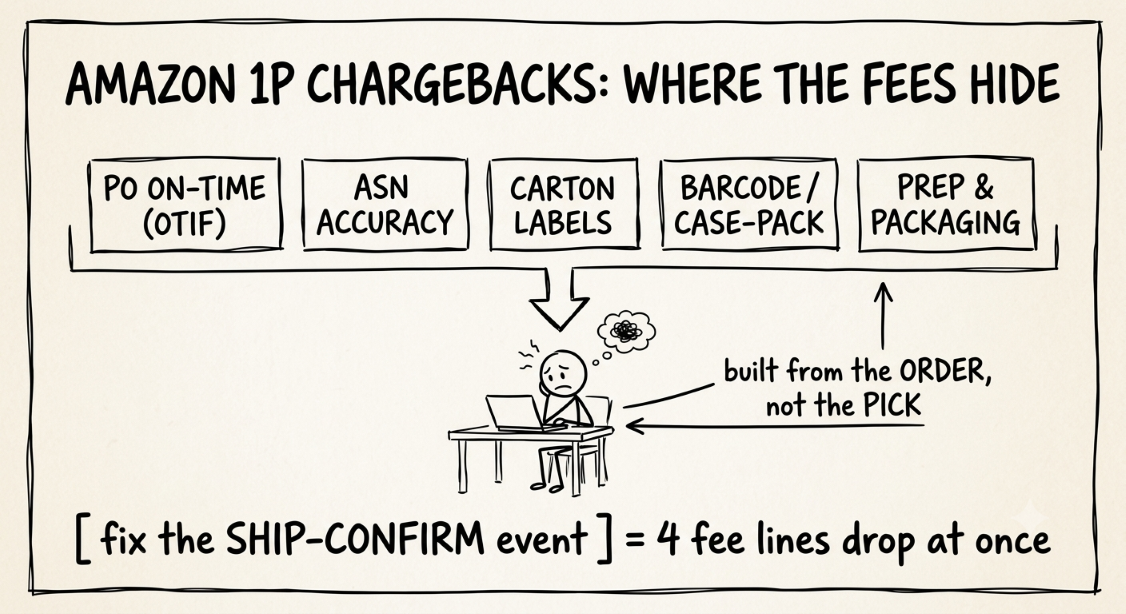
You reduce Amazon Vendor Central chargeback fees by fixing the root cause of each recurring defect, not by disputing charges one at a time. Five categories generate most of the money: PO On-Time Accuracy, ASN Accuracy, Carton Content Accuracy, Non-Compliant Barcode, and prep or packaging failures. Each is preventable before the shipment leaves your dock.
Compiled from public vendor-compliance sources (SPS Commerce / SupplierWiki, Consulterce, iNymbus, RT7 Digital, SalesDuo, Endless Commerce, Amazowl), September 2026. Fee percentages and per-unit amounts are vendor-reported, vary by region and program update, and are flagged inline. Confirm the figure that applies to you in Vendor Central under Operational Performance.
You run supply chain, operations, or finance for a brand that ships to Amazon 1P. The remittance comes in short. You pull the Operational Performance report and find a stack of chargebacks against shipments that arrived on time and intact: ASN Accuracy, Carton Content Accuracy, a barcode fee, a prep charge.
None of it is a warehouse failure. It is a set of small data and labeling defects, each one repeating on every shipment that carries it. SalesDuo, a vendor management agency, reports chargeback exposure running as high as $5,000 per $100,000 of Amazon revenue for vendors who leave those defects unaddressed.
Disputing them back one at a time is recovery work. It is slow, it caps at two attempts per charge, and it changes nothing upstream. The way the fee actually goes down is you stop producing the defect.
This is the map of where the fees concentrate, what triggers each one, and the single prevention step that closes it.
How much do Amazon vendor chargebacks actually cost you?
Amazon’s chargeback program is more transparent than most retailer deduction systems. The categories are published, the fees show up in a structured Vendor Central report rather than a buried remittance line, and the dispute path is documented.
Public vendor sources group the charges into six or seven categories: Purchase Order, ASN, Preparation, Packaging, Transportation, Receive, and, for some vendors, Direct Fulfillment (SPS Commerce, Endless Commerce). Inside those, dozens of sub-types each carry their own fee.
Most of the money lands in five of them. The rest are real but rare for a typical CPG shipper.
What triggers a PO On-Time Accuracy chargeback?
PO On-Time Accuracy fires when the units Amazon confirmed on the purchase order do not arrive inside the required delivery window (SPS Commerce, iNymbus). This is Amazon’s version of OTIF. Three sub-types fire independently: NotOnTime (missed the delivery window), NotFilled (some or all confirmed units never shipped), and DownConfirmed (the confirmed quantity was reduced five or more days after the PO window opened, per Amazowl). A single PO can trigger more than one.
Amazowl puts the fee at 3% of product cost for late or reduced shipments, rising to 10% for units never shipped. Consulterce reports a similar 3-10% of COGS range for North America. The fee is measured against confirmed units, not shipped units. If you confirm a quantity you cannot actually fill, you have booked the chargeback before you pick a single case.
Amazowl also describes a waiver: Amazon reportedly does not charge the fee for a week when a supplier’s trailing four-week on-time rate stays above 90%. That figure is vendor-reported, not confirmed against Amazon’s own documentation.
Prevention: confirm every PO against validated warehouse capacity, not just available-to-promise inventory. If you need to reduce the confirmed quantity, do it inside the first five days of the PO window to avoid a DownConfirmed charge. For prepaid shipments, book the carrier delivery appointment against the Carrier Requested Delivery Date the same day you confirm. The dedicated Amazon PO On-Time Accuracy chargeback entry walks the root causes and the ERP fix.
What triggers an ASN Accuracy chargeback?
ASN Accuracy fires when the Advance Ship Notice you send by EDI does not match what the fulfillment center physically receives. Amazon runs the comparison at the unit level, so it catches more than a quantity gap.
Five sub-types roll up under it, each charged on its own (SPS Commerce, and the Amazon ASN Accuracy chargeback entry):
| Sub-type | Trigger |
|---|---|
| On-Time Non-Compliance | ASN arrived after the shipment did |
| Unit Count Mismatch | ASN quantity does not match the physical count |
| Invalid or Missing ARN | Amazon Reference Number wrong or absent |
| Missing Expiration Date | consumable SKUs shipped without expiration data |
| PRO/BOL Mismatch | carrier tracking data does not match the shipment |
Consulterce reports the ASN Accuracy fee at 2 to 6% of cost of goods, varying by region and severity. A late ASN carrying a wrong quantity is two charges, not one. Across retailers, a single bad ASN can cascade into five separate chargeback categories from one shipment, each filed as a separate event.
Prevention: generate the ASN from the warehouse ship-confirm event, never from the sales order or the PO. The order says what should ship. The confirmed pick says what did. When your ERP builds the 856 from the order, it is wrong before it transmits. This is the same failure mode the EDI 856 breakdown covers for every retailer.
What triggers a Carton Content Accuracy chargeback?
Carton Content Accuracy fires when the carton the fulfillment center opens does not hold what the carton content label and the ASN said it would (SPS Commerce). A related pair, No Carton Content Label and No PO Label on Carton, fires when the label is missing outright.
This is a labeling and pack-out defect, not a shipping error. The goods are on the dock. The scanner cannot reconcile the box to the data, so the whole carton reads as a discrepancy.
Prevention: print carton content labels from the same confirmed-pick record that feeds the ASN, so the label, the box, and the 856 all come from one source. Verify the SSCC-18 or AMZNCC barcode scans cleanly before the pallet ships.
What triggers a Non-Compliant Barcode chargeback?
A Non-Compliant Barcode chargeback fires when a shipped unit has no scannable item barcode, or when the wrong barcode is visible. The classic case-pack version: an item-level barcode is showing on a master pack that is not the sellable unit, so the scanner picks up the wrong code.
SPS Commerce reports a case-pack defect fee of $26 per non-compliant unit. That figure is single-sourced here, so treat it as one vendor’s reported experience and confirm the fee that applies to your account in Operational Performance.
Prevention: confirm each SKU’s Amazon pack configuration in the item setup, and make sure the sellable-unit barcode is the only item barcode a receiver can scan on the outside of the pack. Cover or remove case-level item barcodes.
What triggers prep and packaging chargebacks?
Prep chargebacks cover bagging, suffocation warnings, bubble wrap, poly-bag stickering, taping, cap seals, and opaque covering (SPS Commerce). Packaging chargebacks cover Frustration-Free Packaging and Ships-in-Own-Container requirements. Each non-compliant unit is charged.
These are the easiest category to fix and the easiest to ignore, because each fee is small. Across a full truck they add up to a line worth auditing.
Prevention: pull the prep requirements for each ASIN from Vendor Central once, build them into a pack-out SOP by SKU, and audit a sample carton against the SOP before every shipment rather than after the chargeback.
Which fees are recoverable, and how long you have
Amazon gives you 30 days from the chargeback notification to dispute, and two attempts per chargeback. If the first is denied, you can refile with more evidence within 30 days of the denial. Multiple vendor sources confirm both limits, and the dispute-deadline reference table puts Amazon next to Walmart, Target, and Kroger.
RT7 Digital reports a roughly 70% dispute success rate when the submission carries a complete evidence set. What counts as complete depends on the chargeback type: ASN and PO On-Time disputes need EDI 856 transmission logs, warehouse ship-confirm records, carrier proof of delivery, and appointment confirmations. Barcode and prep disputes need photos of compliant packaging and the item-setup documentation from Vendor Central. That 70% figure is the firm’s own experience, not an audited industry number.
The recoverable fees are the ones issued in error: a chargeback for a defect your records show did not happen. Build the deduction evidence pack before you file: the six documents that turn a dispute from a complaint into a case. A chargeback for a defect that did happen is not a dispute, it is a signal to fix the process.
Where do these chargeback fees actually come from?
Three of the five categories above have an ERP-side root cause. ASN Accuracy and Carton Content Accuracy fire because the ASN and the carton label are built from the sales order instead of the confirmed pick. PO On-Time Accuracy fires because the PO confirmation checks available-to-promise inventory instead of real warehouse capacity and ship-window feasibility.
The order records what should ship. The confirmed pick records what did. When your NetSuite or Business Central setup fires the EDI 856 off the sales order, the ASN and every label it generates inherit that gap. Fix the ship-confirm event once and two chargeback categories drop together. Fix the PO confirmation logic and a third drops.
The remaining two, barcode and prep, are physical compliance problems: wrong barcode visible on the pack, missing suffocation labels, non-compliant packaging. Those require pack-out SOPs and item-setup audits, not an integration change.
Our data-bridge assessment traces a recurring chargeback to the specific ERP event or process gap that produced it, and the OTIF calculator sizes what the pattern costs across your full retailer mix before you decide what to fix first.
If Amazon is your first major retail account, these chargebacks are part of a broader compliance gap. Our retail-ready vs distribution-ready checklist covers all six areas where new suppliers get hit.
Confirm the numbers against your own account
None of the fee figures on this page come from Amazon directly. Every one is vendor-reported, linked inline, and flagged where a single source carries it. Fee percentages and per-unit amounts shift by region and program update.
Your Operational Performance report in Vendor Central has the numbers that apply to your account. If it disagrees with anything here, the portal wins.
Tell us what you are seeing on your remittance and we will correct the page.
Last reviewed: September 2026.
Frequently Asked Questions
- How much do Amazon vendor chargebacks cost?
- Vendor recovery firms report total chargeback exposure running as high as 5% of Amazon revenue, roughly $5,000 per $100,000, for vendors with unaddressed defects (SalesDuo). Individual fees vary by type: PO On-Time Accuracy is reported at 3% of product cost, rising to 10% for units never shipped (Amazowl, Consulterce). ASN Accuracy is reported at 2 to 6% of cost of goods (Consulterce). A case-pack barcode defect is reported at $26 per non-compliant unit (SPS Commerce). Your own Operational Performance report in Vendor Central has the figures that apply to your account.
- Can you dispute an Amazon vendor chargeback?
- Yes. Amazon gives you 30 days from the chargeback notification to dispute it in Vendor Central, and two dispute attempts per chargeback. Multiple vendor sources confirm both. RT7 Digital reports a roughly 70% success rate when the dispute includes a complete evidence set: EDI transmission logs, carrier proof of delivery, and appointment confirmations.
- What is the most common Amazon vendor chargeback?
- PO On-Time Accuracy and ASN Accuracy are the two categories vendors cite most often. PO On-Time Accuracy fires when confirmed units miss the delivery window. ASN Accuracy fires when the Advance Ship Notice does not match what the fulfillment center receives at the unit level. Both hit shipments that otherwise look clean.
- What is OTIF for Amazon vendors?
- OTIF means on-time, in-full. For Amazon 1P it maps to PO On-Time Accuracy: the units Amazon confirmed on the purchase order have to arrive inside the required window and match the confirmed quantity. A short shipment and a late shipment are measured separately, and a single delivery can fail both. See [what OTIF actually costs](/articles/what-is-otif.html).
- Does disputing a chargeback stop it from happening again?
- No. A dispute recovers one fee. It does nothing to the process that produced it. If your ERP builds the ASN from the order quantity instead of the confirmed pick, the next shipment carries the same defect and the same chargeback. Reducing the fee means changing where the data comes from, not winning the dispute.
Find out what your deductions are actually costing you.
A 30-minute call with the founder, who will tell you which of the three scans fits your problem, or that none of them do.