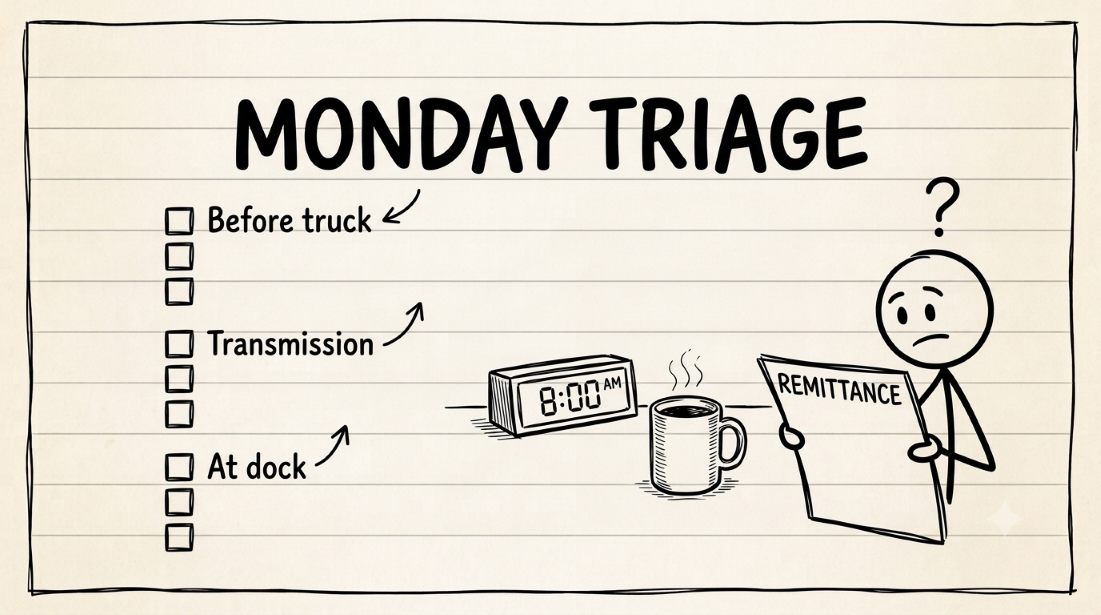
Before blaming the carrier for an OTIF deduction, check nine things in order: PO version match, pick completion, ASN-to-pick match, ASN send time against the retailer cutoff, 997 acknowledgment, 824 content response, appointment request timing, carrier arrival time, and retailer receiving record. The first mismatch you find is your root cause. Pull four timestamps for each flagged PO before the meeting starts: pick confirm, ASN send, appointment confirmation, and retailer receipt.
Based on public EDI and compliance documentation from SPS Commerce, BOLD VAN, Confido, Endless Commerce, and DOSS, September 2026. Individual retailer scoring rules, dispute windows, and chargeback thresholds vary by program.
You’re the Director of Supply Chain at a $45M CPG brand, and OTIF dropped six points this period. The weekly scorecard meeting starts in 40 minutes. Your logistics manager already has the answer ready: the carrier was late on three POs.
That may be true. It may also be the answer your team reaches every Monday because carrier performance is the easiest thing to measure and the hardest thing to disprove in a 30-minute meeting.
BOLD VAN reports that the majority of chargebacks in CPG aren’t caused by operational failures at the dock. They’re caused by mapping failures in the data: incorrect or late ASNs, barcode mismatches, and invoice errors. Endless Commerce puts the dispute win rate at 75 to 80% when filed within seven days of the deduction, dropping to 15 to 20% after 60 days.
Every Monday that your team spends debating the carrier instead of checking ASN timing, pick completion, and appointment status is a week closer to that 15% window.
Start with the scorecard, then split into buckets
The scorecard isn’t the full answer. It’s the starting point.
Pull every PO that missed this period and sort it:
| Bucket | What it tells you | First owner |
|---|---|---|
| On-time miss only | Arrived outside the window | Logistics |
| In-full miss only | Quantity gap between ASN and receipt | Planning or warehouse |
| On-time and in-full miss | Could be stock, carrier, or ASN | Ops lead |
| ASN-related miss | Data issue or timing issue | EDI or systems |
| Unknown code | Needs remittance and portal review | Finance plus Ops |
Sort first. Debate after. If you argue root cause before sorting, the loudest voice in the room wins. That voice is almost always carrier blame, because carrier performance is the one metric everyone can see without opening a second system.
What four timestamps should you pull before an OTIF meeting?
The fastest triage is four timestamps per flagged PO.
| Timestamp | Why it matters |
|---|---|
| Pick confirm time | Shows when the warehouse finished the order |
| ASN send time | Shows when the retailer was told what was coming |
| Appointment confirmation time | Shows whether the delivery slot was real |
| Arrival or receipt time | Shows whether freight hit the window |
Your carrier can be late. Your ASN can be later. The retailer may penalize either one. If those four timestamps aren’t in the same view, your team argues from memory. Memory loses to the remittance.
Check the PO before you check the truck
Many misses start before freight moves. The PO changed. The case pack changed. The ship window moved. Your ERP still holds the first version while the retailer scored the second.
Pull the PO from the retailer portal. Compare it against the ERP order. Check:
- PO number
- Ship window
- Item number and case pack
- Order quantity
- Requested delivery date
- Routing instructions
If the PO changed and your ERP didn’t update, the carrier isn’t the root cause. Your order bridge is. The fix is PO change-order capture before warehouse release.
Check the pick before you check the ASN
Your EDI 856 can only be as right as the pick record behind it.
Pull the WMS or 3PL pick detail. Compare it to the order line. You’re looking for short picks, substitutions, split shipments, late allocation, manual quantity edits, and carton count changes after ASN generation.
A common pattern: the team ships what inventory allows, the ASN reports what the ERP expected, the retailer receives what the warehouse packed, and the invoice bills something else. That’s four systems telling different stories about one shipment. If your team treats each version as its own problem, it files four investigations for one root cause.
Check the ASN before you accept the fine
Open the 856 file your EDI provider transmitted. Don’t rely on the ERP shipment screen. The screen may say shipped. The ASN may carry the wrong pack count, or the right count may have gone out after the retailer’s cutoff window.
Check these fields:
- ASN send time against the retailer’s cutoff
- PO reference
- Item identifiers and GTIN
- Carton count and case quantity
- Pack hierarchy
- 997 status (syntax acceptance)
- 824 response (business content acceptance, if the retailer sends one)
A clean 997 is not the finish line. It confirms the file parsed. It doesn’t confirm the retailer accepted the shipment content. If your team treats the 997 as approval, the real failure may show up weeks later on the remittance.
Check appointment status before blaming carrier performance
A late delivery isn’t always a late carrier. Sometimes the appointment was requested too late. Sometimes the retailer moved the slot. Sometimes the 3PL missed the routing guide.
Pull the appointment trail: requested appointment, confirmed appointment, any revisions, arrival time, unload time, detention notes, and exception notes.
Then ask one question: did the process fail before the truck moved?
If the appointment was requested late, fix tendering or routing compliance. If the appointment was confirmed and the carrier arrived late, review carrier performance. If the carrier arrived on time but the unload was delayed, capture the exception for the dispute. Those are three different fixes, and the appointment trail tells you which one you need.
Separate dispute work from fix work
This is where meetings go wrong. The team tries to decide whether to dispute and what to fix in the same conversation.
Split the work into four outputs:
| Question | Output |
|---|---|
| Can you prove the retailer is wrong? | Dispute file using the evidence pack |
| Can you prove your process caused it? | Fix list for the root cause |
| Can you prove the carrier caused it? | Carrier claim or scorecard review |
| Can you not prove anything yet? | Data capture fix |
A deduction can be invalid and still reveal a weak process. A deduction can be valid and still be preventable next month. The point is to stop paying for the same failure twice.
How do you run a 30-minute OTIF deduction meeting?
Use this order:
- Finance shows the deduction line and dollar amount.
- Ops shows the affected POs sorted into the five buckets above.
- Warehouse shows pick completion and any short-pick exceptions.
- EDI owner shows ASN send time, 997 status, and 824 status.
- Logistics shows the appointment and delivery trail.
- The owner tags each PO: dispute, fix, carrier, or unknown.
- The team assigns one next action per PO.
If your meeting ends without a next action per PO, it was a status review disguised as a triage. Status reviews don’t reduce deductions. They just explain them with a better story each week.
Check your dispute deadlines by retailer before the meeting. If a dispute window is closing this week, that PO gets discussed first.
What to do next
If this meeting happens every Monday, the content of the meeting is your deduction roadmap. The same two or three root causes will keep appearing. Those are the fixes worth building.
Pixels & Clicks can trace 90 days of scorecard and remittance data into a root-cause report through the OTIF Deduction Assessment. The output is the root cause, the recoverable amount, and the fix list.
The OTIF deduction calculator can give you a rough number in five minutes. The assessment gives you the evidence trail behind it.
If your team already knows the root cause but needs the evidence pack to dispute, start there. If a bad ASN is creating multiple chargebacks from the same PO, the ASN is the place to look first.
Walmart’s OTIF fine is a program-level chargeback, not a per-shipment claim. If your misses are accumulating into a scorecard penalty rather than individual deductions, that article covers how the 3% rate is applied.
The disclaimer: retailer portals, scoring rules, and chargeback thresholds change. Verify current program details in your own retailer portal before acting on anything reported here.
Frequently Asked Questions
- What should I check before blaming the carrier for an OTIF deduction?
- Check nine things: whether the PO changed after confirmation, whether the warehouse picked the full quantity, whether the ASN matched the pick, whether the ASN transmitted before the retailer's cutoff, whether the 997 came back clean, whether an 824 flagged a content error, whether the delivery appointment was requested on time, whether the carrier arrived inside the window, and whether the retailer's receiving record matched the ASN. The first mismatch tells you where to work.
- How do I run a 30-minute OTIF deduction meeting?
- Use this order: Finance shows the deduction line and dollar amount. Ops pulls the affected POs. Warehouse shows pick completion and short-pick exceptions. The EDI owner shows ASN send time, 997, and 824 status. Logistics shows the appointment and delivery trail. Then tag each PO as dispute, fix, carrier, or unknown, and assign one next action per PO.
- What four timestamps should I pull before an OTIF meeting?
- Pick confirm time (when the warehouse finished the order), ASN send time (when the retailer was told what was coming), appointment confirmation time (whether the delivery slot was real), and arrival or receipt time (whether freight hit the window). If those four don't line up, you don't have a freight issue yet. You have a timeline issue.
- Can a clean 997 mean my ASN still failed?
- Yes. A 997 confirms the file parsed without syntax errors. It doesn't confirm the retailer accepted the business content: quantities, item identifiers, pack hierarchy, or shipment date. Business-level rejection comes back on the 824, if the retailer sends one. A clean 997 with no 824 follow-up is not proof of acceptance.
Find out what your deductions are actually costing you.
A 30-minute call with the founder, who will tell you which of the three scans fits your problem, or that none of them do.