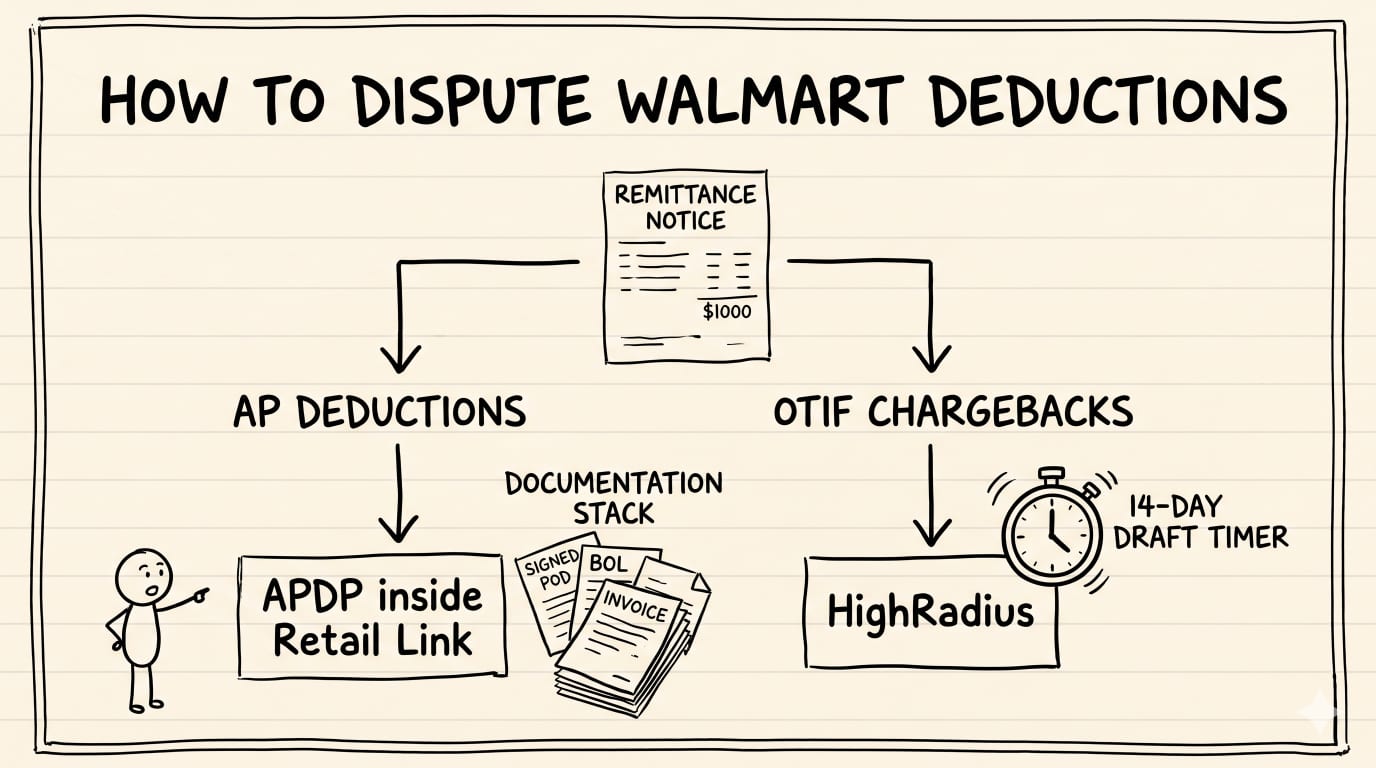
Walmart routes AP deductions and shortages through APDP inside Retail Link. OTIF compliance chargebacks go to HighRadius, which has a separate login outside Retail Link. APDP has a 14-day draft timer: open a case and don't submit it within 14 days and it auto-closes without warning. Filing in the wrong portal, or letting a draft expire, kills a valid claim before the posted deadline.
Portal and window data from SPS Commerce, Glimpse, and Confido, cross-referenced August 2026. Walmart adjusts programs through Retail Link without public announcements; confirm windows in your own portal before filing.
Walmart runs two dispute systems. Most deductions file through APDP inside Retail Link. OTIF compliance chargebacks go to HighRadius, which runs outside Retail Link and has a separate login.
Walmart doesn’t label which portal to use on the remittance. The deduction shows a code and a dollar amount. You have to know the code maps to OTIF to file in HighRadius. File an OTIF chargeback in APDP and Walmart rejects it without review. Your 30-day HighRadius window still expires.
The deduction dispute windows for Walmart, Target, Amazon, and Kroger cover the posted deadlines by retailer. This guide covers what happens after you identify the deduction: which portal, what documentation, and the internal timer inside APDP that closes cases early.
Which Portal Routes Which Deduction
APDP handles AP deductions, shortage claims, billing errors, and routing chargebacks. All go through Retail Link. HighRadius handles OTIF compliance chargebacks only, with a separate login.
| Deduction type | Portal | Dispute window |
|---|---|---|
| AP deductions | APDP (Retail Link) | 2 years |
| Shortage claims | APDP (Retail Link) | 12 months |
| Billing errors and pricing disputes | APDP (Retail Link) | 2 years |
| Routing chargebacks | APDP (Retail Link) | Varies |
| OTIF compliance chargebacks | HighRadius (separate login) | 30 days |
The deduction code lookup confirms the portal for any Walmart code. Check it before you open a case; the wrong portal wastes the dispute window.
One more routing detail: Walmart’s Synergy system handles some supplier income claims and certain vendor income-agreement disputes. If the deduction code doesn’t appear in APDP and doesn’t match OTIF, check whether it’s a vendor income item first.
What to Gather Before You Log In
A case filed without complete documentation can be denied even when the deduction is invalid.
| Deduction type | Required documents |
|---|---|
| Shortage claim | Signed POD (DC receiver signature required, not carrier-only), BOL, carrier delivery confirmation, invoice. Add packing slips for quantity disputes. |
| Billing error / pricing dispute | Original PO, invoice, and documentation showing the correct amount: a pricing agreement, promotional agreement, or corrected PO. |
| Routing chargeback | Routing guide version followed, carrier appointment confirmation record. |
Gather the full package before opening the case. The 14-day draft timer starts the moment you open it, not when you attach the first document.
The APDP Filing Steps
Log into Retail Link and open APDP. Search by invoice number, check number, or PO number.
Select the deduction line. Choose a dispute reason from the dropdown. The reason codes map directly to deduction type; a wrong reason code is a common rejection trigger.
Attach your documentation as a single merged PDF if possible. APDP accepts PDFs and images; a merged file reduces the chance a document gets missed in review.
Confirm submission. APDP saves a draft automatically when you open the case. The draft is not a filed dispute. You have to click through to the submission confirmation screen. If you stop before that screen, the case is still a draft and the timer is running.
The 14-Day Draft Timer
APDP saves every case you open as a draft. The draft timer runs for 14 days from when you open the case. After 14 days, it auto-closes.
Walmart doesn’t send a warning. The case disappears from your open queue.
Two patterns cause this more than any other: opening a case to hold a place while still gathering documentation, and stopping at the document-upload screen without clicking through to the confirmation. Both look like open cases in APDP until the timer expires.
Don’t open a case until you have the complete documentation package assembled. Gather first, then open and submit in the same session. If you manage disputes across dozens of deductions, track case-open dates separately from submission confirmations.
After You File
APDP shows three status codes on submitted disputes:
| Status | What to do |
|---|---|
| Pending | No action; not yet reviewed |
| Under Review | No action; Walmart has it |
| Additional Documentation Requested | Respond before the response window closes; missing it closes the case as denied |
AP deduction disputes average 60 to 90 days to resolve. Shortage claims run longer when Walmart opens an internal receiving investigation. HighRadius OTIF disputes typically close faster.
Walmart doesn’t allow reopening a denied or expired case through either portal. The escalation path after denial is through your buyer or category manager, with no guarantee of recovery.
The Deduction Dispute Lookup covers every portal and window for Walmart, Target, Amazon, and Kroger.
If your dispute volume is high enough that the process itself is consuming significant labor, the OTIF Deduction Assessment identifies where in the fulfillment and EDI chain your deductions are starting before they reach the dispute stage.
What Gets a Dispute Denied
Most APDP rejections are procedural, not about the merits.
| Reason | What happened |
|---|---|
| Wrong portal | OTIF chargeback filed in APDP; rejected without review. The 30-day HighRadius window still expires. Use the deduction code lookup if you’re unsure which system to file in. |
| Wrong reason code | Reason code doesn’t match deduction type; returned unprocessed. |
| Unsigned POD | Carrier-stamped only, no DC receiver signature. Walmart treats it as unconfirmed delivery. |
| Missing invoice correlation | PO or invoice number absent; case can’t be matched to a line item. |
| Expired draft | Documents attached but submission not confirmed before the 14-day timer lapsed. |
A winning shortage dispute package: a signed POD with a DC receiver’s stamp, a BOL showing the full count that shipped, the carrier’s PRO number and confirmed delivery record, packing slips showing case count, and the invoice with matching SKU-level detail. Send it as one merged PDF; multiple attachments get missed more often in review.
For a billing error or pricing dispute, add the original signed PO and documentation showing the price mismatch: a promotional agreement, a price change authorization, or a corrected PO dated before the shipment.
If Walmart Denies the Dispute
APDP doesn’t allow reopening a denied case. The escalation path runs outside the portal.
For high-dollar denied disputes (typically above $5,000), many suppliers escalate through their category buyer. The buyer can’t reverse an APDP decision, but they can flag the account for administrative review. That path takes weeks to months with no guaranteed outcome.
For patterns of similar denials (same code, same documentation, same result across multiple disputes), the fix is upstream. A single process change that ensures PODs are signed before cases open will recover more than a stack of post-denial escalations.
For teams managing more than 20 active disputes at a time, track case-open dates separately from submission confirmations. APDP won’t warn when a timer is close to expiring.
The Deduction Management hub covers every stage of the deduction cycle: decoding the code, building the evidence pack, and preventing recurrence.
Frequently Asked Questions
- What is APDP and where do I find it?
- APDP stands for Accounts Payable Deduction Portal. It's Walmart's primary dispute filing system, accessible from inside Retail Link. Most deduction types route through APDP: AP deductions, shortage claims, billing errors, and routing chargebacks. OTIF compliance chargebacks are the exception and go to HighRadius instead.
- How do I know if a Walmart deduction goes to APDP or HighRadius?
- OTIF compliance chargebacks route to HighRadius. All other deduction types go to APDP: shortages, AP deductions, invoice errors, and routing chargebacks. Filing an OTIF chargeback in APDP results in rejection without review. The HighRadius window is 30 days from the chargeback notice. Use the Deduction Code Decoder to confirm which portal your code uses before you open a case.
- What is the 14-day draft timer in APDP?
- When you open a dispute case in APDP, it saves as a draft. If you don't submit the draft within 14 days, the case auto-closes. APDP doesn't send a warning before it closes. The draft timer runs from when you first open the case, not from when you attach documents or think you've hit submit. This timer is separate from the posted dispute window and can expire a valid claim weeks before the published deadline.
- What documentation does Walmart require for a shortage claim?
- At minimum: a signed proof of delivery, bill of lading, carrier confirmation of delivery, and the original invoice. For a quantity shortage, packing slips showing what physically shipped also help. Walmart can deny a shortage dispute if the POD isn't signed by a receiver at the DC. Gather the full package before you open the case in APDP; the 14-day draft timer starts the moment you open it.
- How long does it take Walmart to resolve a dispute?
- AP deduction disputes through APDP take 60 to 90 days on average. Shortage claims run longer if Walmart opens an internal receiving investigation. HighRadius OTIF disputes typically resolve faster but within the tight 30-day window. APDP shows status codes (Pending, Under Review, Additional Documentation Requested) but doesn't estimate a resolution date.
- Can I reopen a closed APDP dispute?
- No. A case that closes, whether from the 14-day draft timer expiring or a Walmart denial, can't be reopened through APDP. Some suppliers escalate through their Walmart buyer or category manager. The cleaner path is submitting complete documentation before the internal timer expires.
Find out what your deductions are actually costing you.
A 30-minute call with the founder, who will tell you which of the three scans fits your problem, or that none of them do.