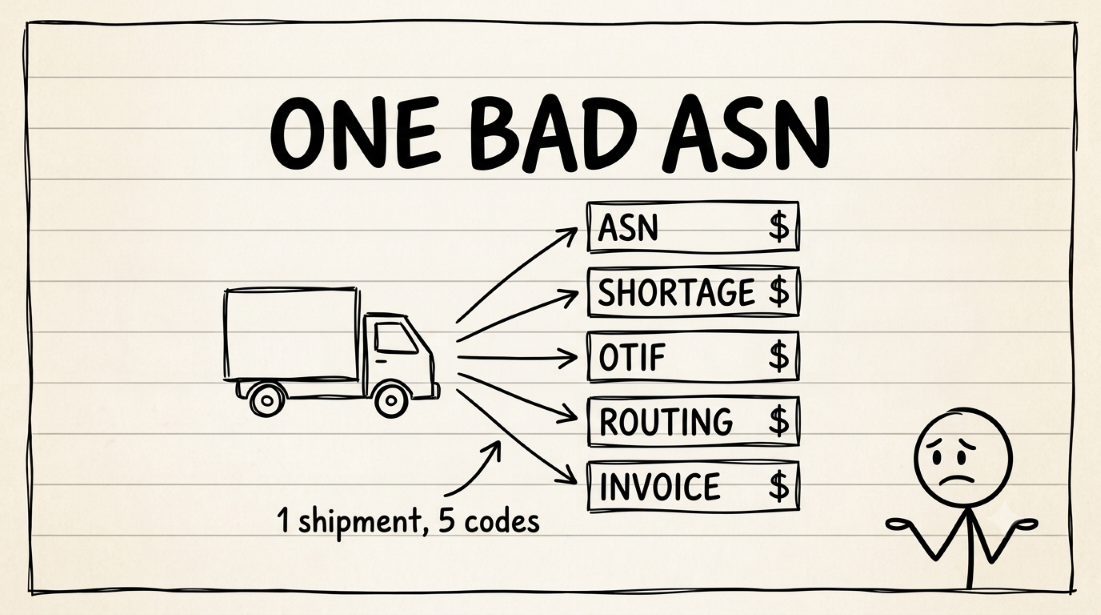
A single bad EDI 856 ASN can trigger five separate chargebacks from one shipment: ASN accuracy, shortage, OTIF, routing or appointment exception, and invoice mismatch. Each chargeback has its own code and dispute path, but they share one root cause. Fixing them as five separate events misses the pattern is like playing whack a mole. Fixing the root cause ASN process closes all five.
Based on public EDI and compliance documentation from SPS Commerce, Orderful, BOLD VAN, Inmar, and Consulterce, September 2026. Fee percentages are vendor-reported and vary by retailer and program update.
You’re running operations for a CPG brand shipping into a major retailer, and five chargebacks just showed up on this month’s remittance. Different codes, different dollar amounts. Your finance team logs them as five separate issues: an ASN accuracy hit, a shortage claim, an OTIF penalty, a routing exception, and an invoice mismatch.
Five people get five emails. Five investigations start from five different records.
All five trace back to one PO, one shipment or one carton-count change that happened after the EDI 856 was already transmitted.
SPS Commerce reports that even well-run operations see 1 to 2% of revenue in preventable deductions. BOLD VAN notes that the majority of chargebacks in CPG aren’t caused by operational failures at the dock. They’re caused by mapping failures in the data, and individual penalties are “frequently multiplied by order or SKU count.”
When your team reviews those five codes separately, it can’t see the shared cause. Each investigation concludes on its own and costs its own labor. The next month, the same error repeats.
The shipment
Here’s how it happens. A $40M snack brand ships 1,000 cases across 5 SKUs to a retailer DC. The PO specifies a delivery window, a case-pack structure, and an ASN before arrival.
The warehouse picks the order. During packing, a carton count changes: the team consolidates two partial pallets into one, reducing the carton count from 22 to 20.
The ASN was already generated and transmitted with the original 22-carton count.
The truck leaves with 20 cartons holding the same 1,000 cases. Physically, the shipment is complete. In the data, the shipment disagrees with itself.
That gap between the ASN and the physical load is the single point of failure. Here’s what it produces.
What triggers an ASN accuracy chargeback?
The retailer’s DC scans the inbound shipment and counts 20 cartons. The 856 said 22. The item quantities inside the cartons may be correct, but the carton-level pack hierarchy doesn’t reconcile.
Consulterce reports Amazon’s ASN accuracy chargeback at 2 to 6% of cost of goods, varying by region and compliance tier. Orderful calls the ASN “one of the most critical documents in the retail EDI process” across major retailers.
The fix isn’t at the receiving dock. It’s in the gap between your warehouse confirmation and your ASN transmission. If the ASN goes out before the physical shipment is finalized, any change after transmission creates this chargeback.
Why does a carton-count mismatch become a shortage claim?
The same carton-count mismatch can become a shortage claim. The retailer’s system expected 22 cartons based on the ASN. It received 20. If the item-level receiving process counts by scanning carton labels rather than opening each carton, the two missing cartons register as missing units.
Your warehouse shipped the full 1,000 cases. The retailer’s system recorded fewer. Now Finance sees a short payment on the remittance under a shortage code, and the team pulls the POD to dispute it. The POD shows 20 cartons delivered, which matches what arrived but doesn’t match the ASN.
This is the same error wearing a different code. Your team treats it as a second, unrelated deduction.
How does one late shipment fail both OTIF measures?
The pick delay that caused the carton consolidation also pushed the shipment timeline. The ASN transmitted on time based on the original pick plan, but the physical shipment left four hours later. The carrier missed the confirmed appointment window by 45 minutes.
Walmart’s OTIF fine runs 3% of cost of goods on non-compliant cases. The ASN arrived on time. The truck didn’t. The scorecard records an on-time miss. If the carton-count change also reduced the delivered quantity against the PO, the in-full side fails too.
One shipment can fail both the on-time and in-full components of OTIF, each scored separately.
What causes a routing or appointment exception chargeback?
The late pick cascaded into a late routing action. The appointment was requested after the retailer’s window for scheduling. The carrier changed the route to make a later slot work, and the load moved outside the original routing instruction.
The retailer sees a routing violation: wrong carrier, wrong appointment sequence, or wrong load configuration. Your logistics team didn’t create this problem. The delayed pick created it, and the ASN timing hid it because the data said the shipment was ready before it was.
Why does an EDI 810 invoice mismatch follow a bad ASN?
Your EDI 810 invoice was generated from the ERP shipment record, which still carries the original 22-carton shipment. The invoice bills for the correct 1,000 cases, but the carton detail and pack-level structure reference the pre-change ASN. The retailer’s AP system compares the 810 against the 856 and the receiving record, and all three disagree.
The result is an invoice discrepancy. Finance can resolve it, but resolving it requires the full evidence pack: PO, pick record, ASN, 997, 824, BOL, POD, retailer receipt, and invoice. Inmar reports that a $200 deduction can require $300 to $500 in staff time to investigate.
What does a five-chargeback cascade actually cost?
The chargeback dollar amounts are the visible cost. The hidden cost is the operating drag around all five investigations.
| Cost layer | Where it shows up |
|---|---|
| Chargeback dollars | Short pay on remittance |
| Dispute labor | Finance, customer service, and EDI team hours per investigation |
| Rework | 3PL follow-up, EDI retransmission, carrier claim |
| Scorecard impact | Retailer compliance score drops, triggering higher scrutiny on future shipments |
| Repeat leakage | Same root cause fires again next month on a different PO |
When your team files five disputes and wins three, it recovers three fees. The root cause stays open. The next shipment with a post-ASN carton change produces the same five hits.
How do you prevent all five chargebacks with one fix?
Every chargeback in this example traces to one gap: the ASN transmitted before the physical shipment was finalized.
The fix: don’t transmit the 856 until the warehouse confirms the final pick, pack, and carton count. Generate the ASN from the ship-confirm record, not the order-release record.
This is a sequencing change, not a system purchase. It requires:
- The WMS or 3PL confirms final carton count and pallet structure
- That confirmation triggers ASN generation in the ERP or EDI connector
- The 856 transmits with the actual shipped data, not the planned data
- The 810 invoice generates from the same confirmed shipment record
BOLD VAN reports that focused remediation on top chargeback categories reduces chargeback volume by 50 to 80% within one to two quarters. When the top category is ASN timing and accuracy, one sequencing change covers most of the exposure.
What to do next
Pull five recent ASN-related deductions. Trace how many other chargebacks on the same remittance point to the same POs.
If one shipment produced multiple hits, don’t file them as five separate events. They’re one root cause.
The OTIF Deduction Assessment traces this chain across 90 days of scorecard and remittance data. The output isn’t a dashboard. It’s the root cause, the recoverable amount, and the fix list.
If you want a rough number first, the OTIF deduction calculator gives you one in five minutes. The assessment gives you the evidence trail behind it.
If your ERP says shipped but the retailer says short, the gap is usually between four quantities from four systems. The root-cause trace walks through where to look.
If deductions are hitting every week and your team is filing reactive disputes, the Monday morning triage catches 80% of preventable chargebacks before Finance writes them off.
Frequently Asked Questions
- Can one shipment really generate five separate chargebacks?
- Yes. A late or inaccurate ASN touches five different compliance categories because the 856 is the document that connects PO fulfillment, warehouse shipment, carrier appointment, retailer receiving, and invoicing. When the ASN is wrong, every system downstream records a different version of the same error, and each version gets its own chargeback code.
- What is the most common ASN error that triggers multiple chargebacks?
- A carton-count change after ASN generation. The warehouse adjusts the physical shipment, but the already-transmitted 856 carries the original count. The retailer receives a quantity that doesn't match the ASN, which triggers an ASN accuracy chargeback and a shortage claim. If the pick change also delayed the shipment, an OTIF miss follows.
- How do I know if my deductions share a single root cause?
- Pull five recent deductions and trace them back to the PO number. If two or more chargebacks on the same remittance point to the same PO, they likely started from one shipment failure. The evidence pack for that PO will show where the chain broke.
- Does fixing the ASN process actually reduce chargebacks from other categories?
- It reduces every chargeback category that depends on the ASN being accurate and on time: shortage claims that started as a count mismatch, OTIF misses that started as a late transmission, and invoice mismatches where the 810 followed the wrong ASN quantity. BOLD VAN reports that focused remediation targeting top chargeback categories reduces chargeback volume by 50 to 80% within one to two quarters.
Find out what your deductions are actually costing you.
A 30-minute call with the founder, who will tell you which of the three scans fits your problem, or that none of them do.