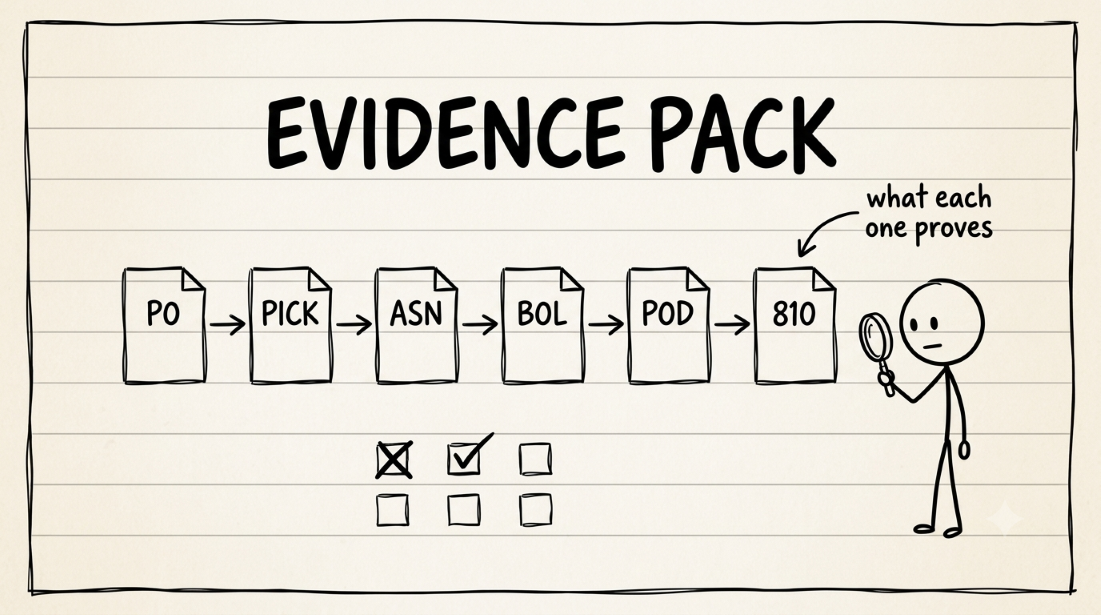
A retail deduction evidence pack is the set of documents you assemble before filing a dispute: purchase order, pick ticket, EDI 856 ASN, bill of lading, proof of delivery, EDI 997 and 824 acknowledgments, invoice, and retailer receiving record. Each document proves one link in the chain. A POD proves the truck arrived. It doesn't prove the ASN was accepted or the invoice matched the PO. You need the full chain.
Based on the public X12 EDI standard, SPS Commerce and Orderful supplier documentation, and Inmar and OverDeduct industry benchmarks, September 2026. Individual retailer dispute requirements vary by program.
You’re a Director of Supply Chain at a $40M snack brand, and a shortage deduction just landed on this week’s Walmart remittance. You pull the proof of delivery. The truck arrived. You pull the invoice. The quantities match. You forward both to Finance with a note: “We shipped this. Dispute it.”
Finance files the dispute. Walmart denies it.
The POD proved delivery happened. It didn’t prove the ASN was accepted. It didn’t prove the picked quantity matched the invoiced quantity. It didn’t prove the retailer’s receiving count agreed with yours. The dispute had two documents and a hope. The retailer had a receiving record that disagreed with both.
Inmar reports that CPG suppliers lose 5 to 15% of gross sales to deductions and chargebacks combined. Up to 10 to 20% of those deductions get written off as unrecoverable, often because the evidence was scattered across too many systems to assemble before the dispute window closed.
The problem isn’t that your team was wrong about the shipment. The problem is that the proof lived in six places and arrived in zero of them as a complete set.
What each document proves and doesn’t prove
Every deduction dispute is a chain-of-custody argument. You’re proving what was ordered, what was picked, what was shipped, what was transmitted, what was acknowledged, and what the retailer says it received. Each document covers one link.
| Document | What it proves | What it doesn’t prove | Where you pull it |
|---|---|---|---|
| Purchase order | What the retailer ordered, at what price, in what window | What you shipped | Retailer portal, ERP |
| Pick ticket | What the warehouse picked | What left the dock or what the ASN declared | WMS, 3PL portal |
| EDI 856 ASN | What you told the retailer was coming | That the retailer accepted the content | EDI provider, ERP |
| EDI 997 | The ASN file parsed without syntax errors | That the retailer accepted the business content | EDI mailbox |
| EDI 824 | The retailer’s business-level response to the ASN | Physical receipt or delivery | EDI mailbox, retailer program |
| BOL / POD | Carrier accepted the load; delivery happened | In-full delivery, clean ASN, or invoice match | TMS, carrier portal |
| Invoice (EDI 810) | What you billed | What shipped or what arrived | ERP, EDI 810 |
| Retailer receiving record | What the retailer says arrived | Whether the retailer’s count is correct | Retailer portal |
If your dispute has only the invoice and POD, it covers two links. The retailer’s denial will point at a link you didn’t cover.
Shortage claims need four numbers, not a delivery confirmation
A shortage deduction says the retailer received fewer units than you billed. Your first instinct is to prove delivery happened. That’s the wrong starting point.
Start with four numbers from four systems:
| Quantity | System | What it answers |
|---|---|---|
| Ordered | PO in ERP | What the retailer asked for |
| Picked | WMS or 3PL | What the warehouse prepared |
| ASN’d | EDI 856 | What you told the retailer was coming |
| Received | Retailer portal | What the retailer counted at the dock |
Put them in one row. The first place they diverge is your dispute path.
If your picked quantity and ASN quantity match, but the retailer’s received quantity is lower, you need BOL detail, POD signature, and pallet-level photos. The gap is between your dock and theirs.
If your picked quantity and ASN quantity don’t match, the retailer may be right. The gap is inside your own operation. Disputing that teaches the retailer you didn’t check your own records.
OTIF disputes need timestamps, not explanations
An OTIF deduction is about timing and fill rate. A paragraph explaining why the carrier was late doesn’t close a dispute. Timestamps do.
Pull these before the dispute goes out:
- Appointment requested time
- Appointment confirmed time
- Carrier pickup time
- ASN send time (from your EDI 856 transmission log)
- 997 return time
- 824 return time, if the retailer sends one
- Delivery arrival time
- Retailer receipt time
Two shipments can look identical on a scorecard and have different root causes. One missed because the truck arrived late. One missed because the ASN transmitted after the retailer’s receiving window. One missed because the pick was short before the truck left. Those are three different fixes, and the timestamps tell you which one you’re arguing.
ASN accuracy disputes need the EDI file, not the ERP screen
An ASN accuracy chargeback asks a narrow question: did the EDI 856 match what the retailer expected and received?
Open the actual 856 file your EDI provider transmitted. Don’t rely on the ERP shipment screen. The ERP may show the correct quantity while the ASN transmitted a different pack hierarchy, wrong carton count, or stale item identifier.
The minimum evidence set for an ASN accuracy dispute:
- Purchase order
- The transmitted 856 file (not the ERP summary)
- 997 acknowledgment
- 824 response, if used
- BOL
- Retailer receiving record
- Invoice
A clean 997 confirms syntax. It doesn’t confirm the retailer accepted the shipment quantities or pack structure. The business-level error may come back on an 824, or it may show up first as money taken off the check.
Pricing disputes need the agreement trail, not just the invoice
A pricing deduction looks like a Finance problem. It often starts in master data.
Pull:
- PO price from the retailer portal
- Invoice price from ERP
- Trade agreement or cost file
- Promo calendar with effective dates
- Item master with case-pack and UOM setup
The question isn’t only whether your invoice was correct against your own records. The question is whether the price you billed matches the price the retailer expected when it created the PO. If the agreement changed after the PO, the dispute needs the effective date. If the item moved from eaches to cases, the dispute needs the UOM trail.
Hold the dispute if the chain is broken
Filing a dispute with a broken evidence chain is worse than not filing. It burns your dispute attempt, and some retailers give you only two.
Hold the dispute if any of these are true:
- The PO version in your ERP doesn’t match the retailer portal
- The ASN quantity doesn’t match the pick ticket
- The 997 came back clean but you haven’t checked for an 824
- The BOL case count is too broad to support the claim (“20 pallets” without per-pallet detail)
- The invoice uses a different UOM than the PO
- You haven’t pulled the retailer’s receiving record yet
Finortal’s 2025 benchmark reports a 31% recovery rate for manual dispute processes and 54% for structured workflows. The difference isn’t better arguing. It’s more complete evidence.
After the dispute: tag the root cause
A recovered deduction is a clue, not a conclusion. If you don’t tag why it happened, the same gap produces the same deduction next month.
Tag every deduction with one root cause:
| Root cause | Fix |
|---|---|
| Warehouse pick error | Pre-ASN pick quantity validation |
| ASN timing | Transmission timestamp alert against retailer cutoff |
| UOM mismatch | Item master cleanup across ERP, WMS, and retailer setup |
| PO version mismatch | PO change-order capture before warehouse release |
| Carrier appointment miss | Appointment confirmation tracker |
| Invoice mismatch | 810 validation against PO and ASN before billing |
Do this for 90 days. The same two or three root causes will explain most of the leakage. Those are the fixes worth building, and they’re what turns deduction recovery into deduction prevention.
What to do next
If deductions are hitting the remittance and your team is disputing with incomplete evidence packs, you have two problems. The dispute process needs the chain above. The operating process needs the root-cause tags.
Pixels & Clicks can trace 90 days of scorecard and remittance data into a root-cause report through the OTIF Deduction Assessment. The output is the root cause, the recoverable amount, and the fix list.
The OTIF deduction calculator can give you a rough number in five minutes. The assessment gives you the evidence trail behind it.
If your ERP says shipped but the retailer deducted for shortage, the gap is usually between four quantities from four systems. The root-cause trace walks through where to look.
If you want a structured weekly check before deductions become permanent, the Monday morning triage covers 9 checks across three phases.
Dispute deadlines vary by retailer. Check the current reported windows before your next filing.
Frequently Asked Questions
- What documents do I need to dispute a retail deduction?
- You need the purchase order, pick ticket or warehouse shipment record, EDI 856 ASN, EDI 997 functional acknowledgment, EDI 824 application advice (if the retailer sends one), bill of lading, proof of delivery, invoice, and the retailer's own receiving record. Each proves one link. The gap between any two adjacent documents is where the deduction started.
- Does a proof of delivery prove a shortage deduction is wrong?
- A POD proves delivery happened. It doesn't prove the delivered quantity matched the ASN, the invoice, or the purchase order. A shortage deduction compares multiple quantities: ordered, picked, ASN'd, and received. The POD covers only one of those. You still need the other documents to show where the count diverged.
- Does a clean EDI 997 mean the retailer accepted my ASN?
- A 997 confirms the file parsed without syntax errors. It doesn't confirm the retailer accepted the business content, the quantities, the item identifiers, or the pack hierarchy. Business-level acceptance or rejection comes back on the EDI 824, if the retailer uses one. Treating the 997 as approval is one of the most common evidence gaps in deduction disputes.
- How long do I have to dispute a retail deduction?
- Dispute windows vary by retailer. Walmart's window for most deduction types is reported at 70 days from the check date. Amazon gives 30 days with two dispute attempts. Target and Kroger each set their own windows by claim type. See our deduction dispute deadlines by retailer for the current reported windows.
Find out what your deductions are actually costing you.
A 30-minute call with the founder, who will tell you which of the three scans fits your problem, or that none of them do.