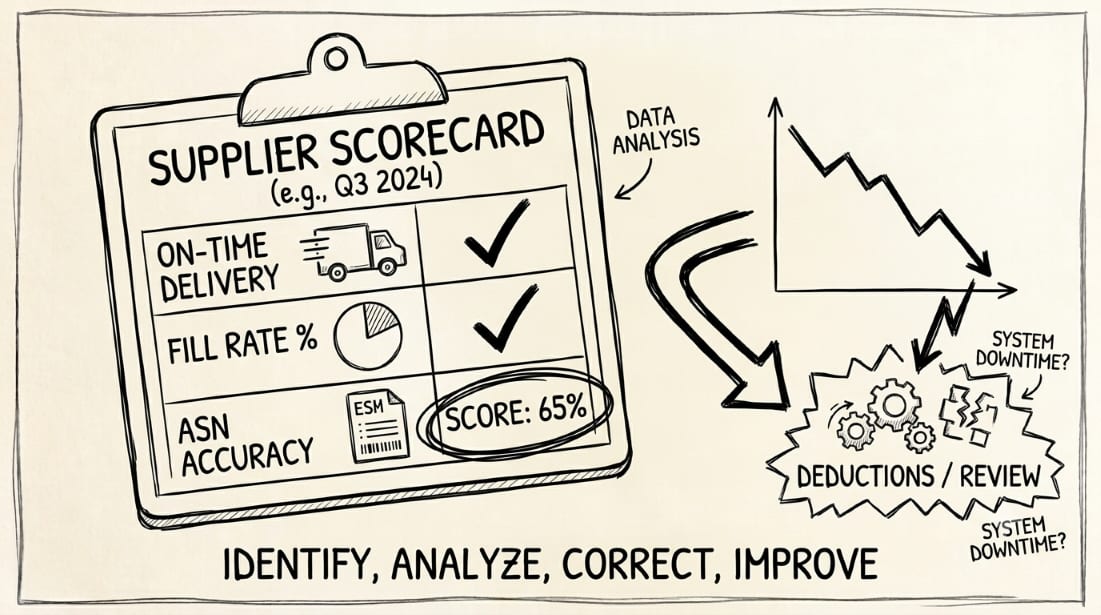
A supplier scorecard is the report card a retailer keeps on each vendor, grading on-time delivery, in-full fill rate, ASN and EDI accuracy, and compliance. Walmart, Target, and Amazon each run their own version. A low score triggers review, fines, and eventually delisting, so the scorecard is the leading indicator of a supplier's deduction risk.
Based on retailer scorecard metrics documented across this site's OTIF, fill-rate, and ASN coverage, November 2026. Each retailer sets its own thresholds and changes them; confirm current terms in your own vendor portal.
Supplier scorecard. This hub maps everything we publish on how retailers grade you: the metrics, the thresholds, and the deductions a low score sets off. Use the routes below to jump to the metric you're fighting.
The scorecard is the leading indicator. Deductions are the lagging one. By the time a fine posts, the score that predicted it has been slipping for weeks, which is why a scorecard trending down is the cheapest warning a supplier gets.
Retailers grade the same few things: did it arrive on time, did it arrive in full, did the paperwork match. Walmart, Target, and Amazon each run their own scorecard, but the metrics rhyme, and a bad score in any of them routes to the same place, fines today and a corrective-action plan or delisting if it holds.
What the scorecard grades
Every retailer scorecard measures a version of these four things. Each links to the deep dive.
| Metric | What it measures | Where it’s covered |
|---|---|---|
| On-time delivery | Deliveries inside the retailer’s receiving window | What is OTIF |
| In-full / fill rate | Units shipped against units ordered | Walmart OTIF fine explained |
| ASN & EDI accuracy | Whether the 856 matches the physical shipment | EDI 856 ASN rejections |
| Compliance | Routing, labeling, and packaging to spec | Retail vendor compliance |
A low score is a forecast of deductions, not just a grade. Read your risk against each retailer’s thresholds with the free scorecard risk scorer. Track the metrics month over month with the supplier scorecard template, and size the fine exposure with the OTIF calculator. An OTIF deduction assessment then traces the misses behind the score back to their root cause in 14 days.
Retailer scorecard metrics and thresholds change without notice. If a figure or program detail here has moved, tell us and we’ll correct it.
Frequently Asked Questions
- What is a supplier scorecard?
- A supplier scorecard, also called a vendor scorecard, is how a retailer measures a vendor's performance over time. It grades delivery, fill rate, documentation accuracy, and compliance, usually against a target the retailer sets. The score drives whether you keep favorable terms, land on a corrective-action plan, or face review and deductions, so it is the retailer's single clearest signal of how you are doing as a supplier.
- What metrics are on a supplier scorecard?
- The core metrics are on-time delivery, in-full fill rate, and ASN or EDI accuracy, often rolled up as OTIF. Retailers add compliance measures for labeling, routing, and packaging, and some include quality and invoice accuracy. On-time and in-full usually carry the most weight, because they predict whether the shelf gets filled when the retailer expects it.
- What is a good supplier scorecard score?
- It depends on the retailer's own threshold, and the bar is high: fill-rate and on-time targets in the high nineties are common, and falling below the line triggers fines rather than a warning. The practical read is simpler than the exact number. A score trending down is an early signal of deductions coming, and a score below the retailer's threshold means they are already posting.
- What is the Walmart supplier scorecard?
- Walmart grades suppliers on OTIF, the on-time and in-full standard enforced through its fine program, visible to vendors in Retail Link. It is one example of the pattern every major retailer follows: a measured target, a penalty for missing it, and a portal where the score lives. Target and Amazon run comparable scorecards with their own metrics and thresholds.
- How do you improve a supplier scorecard?
- Work the metric that carries the most weight first, usually on-time-in-full, then ASN accuracy. Most scorecard misses are not warehouse failures; they trace to a data or document gap between the ASN, the invoice, and the physical shipment. Closing that gap in the ERP and EDI setup lifts the score and cuts the deductions that follow from it at the same time.
Find out what your deductions are actually costing you.
A 30-minute call with the founder, who will tell you which of the three scans fits your problem, or that none of them do.