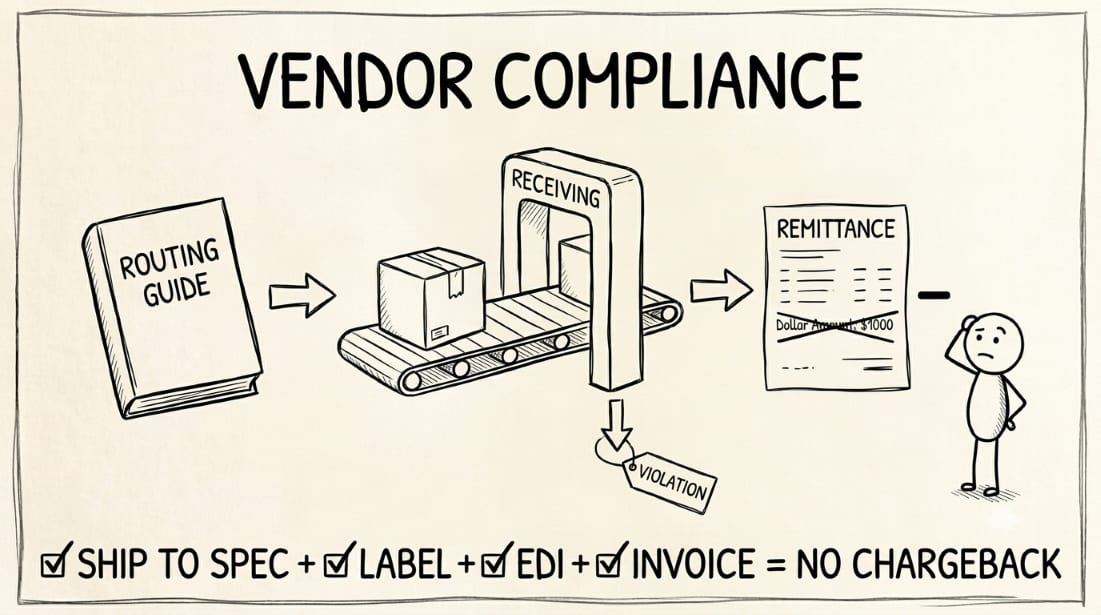
Retail vendor compliance is the set of rules a retailer publishes in its routing guide and vendor agreement covering how you ship, label, pack, and invoice. Break a rule and the retailer issues a chargeback, a deduction pulled off your payment, even when the product itself arrived complete and on time.
Based on retailer compliance terms documented across this site's OTIF and EDI coverage, plus industry description from SPS Commerce, November 2026. Routing guides change without notice; confirm current terms in your own vendor portal.
Vendor compliance. This hub maps everything we publish on retailer compliance: what gets graded, what a miss costs, and where the fix lives. Use the routes below to jump straight to your problem.
Vendor compliance fines your paperwork, not your product. A retailer can pull a percentage off your invoice for how a shipment was labeled, packed, documented, or timed, even when the goods arrived complete and on time.
For a CPG supplier on EDI, it is the largest deduction category you can’t trace to a cause, because the charge posts weeks later under a code. The useful part: most of it is a data mismatch between your own systems and your own paperwork, which makes most of the leak preventable upstream, before the fine ever posts. SPS Commerce describes the routing guide itself as a 60-to-200-page compliance document, with the fee schedule in the back.
The five things retailers grade
Compliance violations fall into five domains. Each has its own root cause, and each links to the deep dive.
| Domain | What triggers the charge | Where it’s covered |
|---|---|---|
| EDI / ASN accuracy | Late 856, invoice-to-PO mismatch, missing acknowledgment | EDI 856 ASN rejections |
| On-time delivery | Shipment outside the retailer’s receiving window | What is OTIF |
| In-full quantity | Short ship against the PO quantity | Walmart OTIF fine explained |
| Labeling and carton config | Wrong SSCC label, carton count, or pallet build | Bad ASN, five chargebacks |
| Routing and packaging | Wrong carrier, missed appointment, non-spec packaging | Retail-ready vs distribution-ready |
One bad shipment can trip several domains at once, which is how a single late, mislabeled, short load draws a timing fine, a labeling fine, and a fill-rate fine on the same purchase order. To size your own exposure, the OTIF calculator estimates annual deduction risk from your on-time and in-full rates, and an OTIF deduction assessment traces every non-compliant shipment back to its root cause.
Retailer routing guides and penalty schedules change without notice. If a figure or program detail here has moved, tell us and we’ll correct it.
Frequently Asked Questions
- What is vendor compliance in retail?
- Vendor compliance is shipping to the specification a retailer publishes in its routing guide and vendor agreement: the delivery window, the pallet and carton configuration, the labels, the EDI documents, and the invoice format. Each retailer writes its own rulebook, so a supplier selling into Walmart, Target, Kroger, and Amazon manages four separate compliance programs at once.
- What is a vendor compliance chargeback?
- A chargeback is a deduction the retailer takes off your payment when a shipment breaks a routing-guide rule. It posts as a coded line on your remittance weeks after delivery. Unlike a product return, it has nothing to do with whether the goods were good. It is a fine for how the shipment or its paperwork failed to match the spec.
- How much do retail compliance chargebacks cost?
- Per-shipment penalties commonly run 1% to 5% of the affected invoice. Walmart applies 3% of cost of goods to non-compliant cases and Target applies 5% with a $150 minimum. Deduction-recovery vendors estimate the total drag at 2% to 5% of gross revenue across a supplier's book, and that 40% to 60% of the charges are preventable or invalid.
- What are the most common vendor compliance violations?
- The five domains retailers grade are EDI and ASN accuracy, on-time delivery, in-full quantity, labeling and carton configuration, and routing and packaging. Many of these trace back to a data or document mismatch in the ERP or EDI setup rather than anything that happened on the warehouse floor.
- How do you dispute a vendor compliance chargeback?
- Each retailer runs its own dispute portal and deadline clock, from Walmart's APDP in Retail Link to Amazon's Vendor Central. You need the shipment evidence, meaning the ASN, the bill of lading, and proof of delivery, filed before the window closes. The dispute deadline is the difference between a recoverable charge and a permanent one.
Find out what your deductions are actually costing you.
A 30-minute call with the founder, who will tell you which of the three scans fits your problem, or that none of them do.